
Field Notes
Designing the MindHYVE workforce
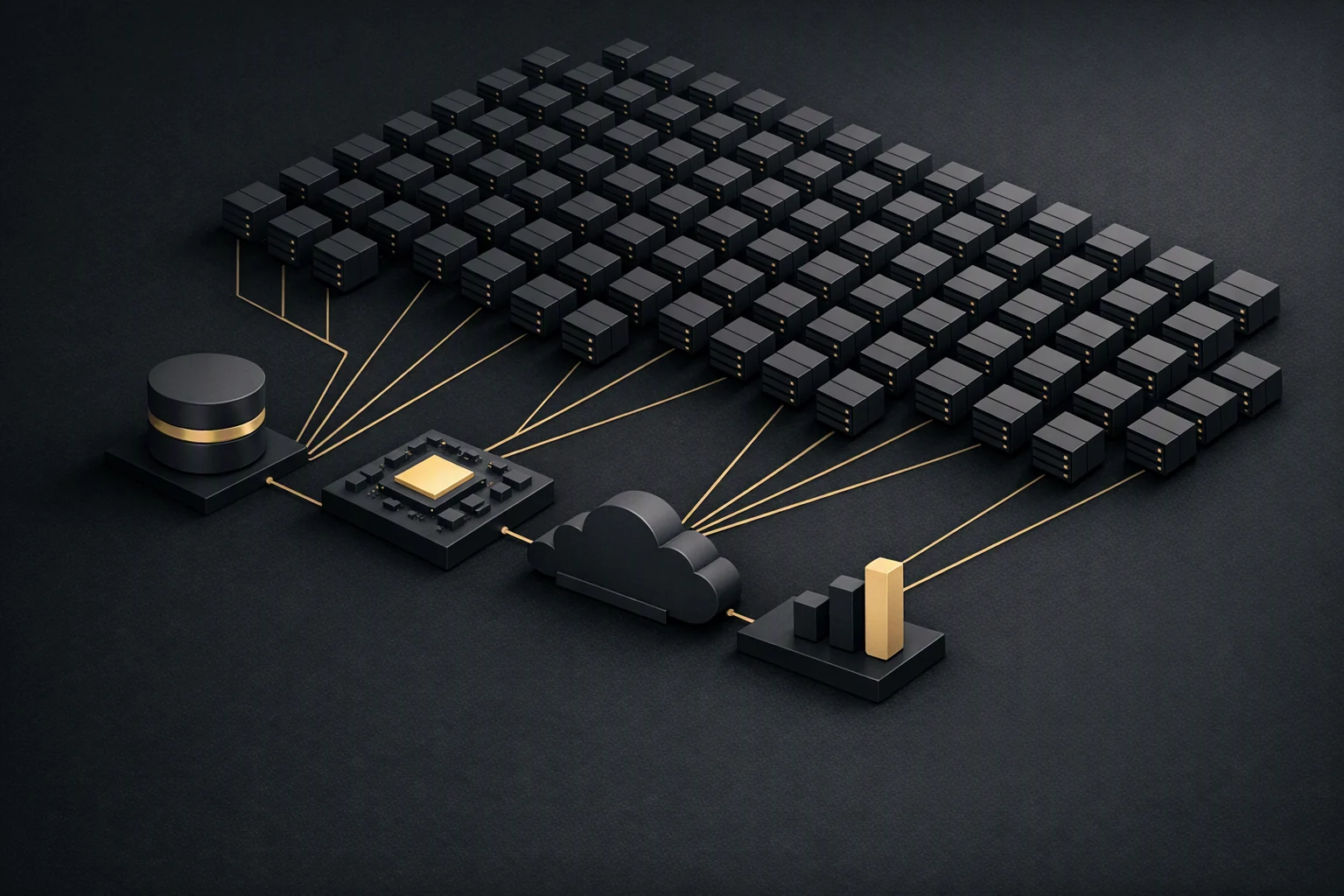
156 humans. 1,500 AI agent instances. 3,000+ person output. This is how MindHYVE is scaling in 2026 — without linear hiring.
Originally published on ciai.ai on January 14, 2026.
As of January 2026, the discussion around AI and the workforce has moved from experimentation to acknowledgment. Major firms are now openly counting AI agents as productive capacity rather than tools.
At MindHYVE™, we are beyond acknowledgment.
We are in the middle of a deliberate workforce transformation — one being rolled out over the next three months that fundamentally changes how scale, cost, and capability are achieved.
At the time of writing, MindHYVE™ operated with approximately 156 employees and contractors. Over the next 90 days, we are deploying a multi-instance, agentic workforce that will give the organization the functional capacity of a 3,000+ person professional services firm, without scaling headcount linearly.
This is not a future-state aspiration. It is a workforce design now being executed.
Why headcount is no longer a meaningful measure of scale
Traditional organizations scale by hiring: more people → more output → more coordination → more cost and friction. That model couples growth directly to payroll, slows decision cycles, and introduces organizational drag as complexity increases. Headcount becomes a proxy for capability — even though it is an increasingly poor one.
MindHYVE™ is intentionally breaking that coupling.
We are scaling governed cognitive capacity, not organizational mass.
Our humans are not optimized for repetitive execution. They are positioned as governors of work, owners of decisions, arbiters of tradeoffs, and accountable stewards of outcomes. Execution, synthesis, simulation, and institutional memory are handled by persistent, governed agent instances, operating continuously and in parallel under human oversight.
The workforce we are rolling out
Rather than deploying a single monolithic system, MindHYVE™ is rolling out multiple concurrent instances of a small number of core agent classes. Each class represents an institutional cognitive function that, in a traditional firm, would require entire departments to sustain. By the end of this rollout, we will be operating approximately 1,500 active agent instances across the organization.
Cognitive Orchestration. Instances of Eve provide strategic synthesis, cross-domain reasoning, and executive decision preparation — replacing large internal strategy and chief-of-staff layers with a persistent reasoning substrate.
Financial & Economic Intelligence. Eli instances continuously model unit economics, pricing, capital allocation, and scenario outcomes. Financial reasoning shifts from periodic analysis to always-on evaluation.
Risk & Probability Intelligence. Issac instances simulate regulatory exposure, operational risk, and downside scenarios before decisions are finalized.
Learning, Training & Apprenticeship. Arthur instances run synthetic apprenticeship programs that develop judgment, not just skills.
Legal & Governance Intelligence. Justine instances interpret contracts, regulatory constraints, and governance boundaries across jurisdictions in real time.
Systems & Engineering Reasoning. Skyler instances evaluate architecture, infrastructure, integration paths, and scaling constraints.
Narrative & Messaging Intelligence. Sage instances maintain narrative integrity across products, markets, and subsidiaries.
Revenue & Commercial Intelligence. Carter instances model go-to-market strategies, pricing, sales motions, and partnerships in parallel.
One human governing the equivalent of more than twenty knowledge workers. This leverage does not remove accountability. It sharpens it.
What this adds up to in output
Once fully deployed, this workforce will operate at the equivalent of approximately 12,000 human-equivalent work hours per day, 60,000 per week, 260,000 per month, 3.12 million per year.
This output is governed by a small human tier, resulting in an effective leverage ratio of roughly one human governing the equivalent of more than twenty knowledge workers.
Crucially, this leverage does not remove accountability. It sharpens it. Agents reason and execute. Humans decide and own consequences.
Rebuilding apprenticeship, not eliminating it
A common concern with agentic systems is the loss of apprenticeship — the fear that removing repetitive execution erodes expertise.
Our experience suggests the opposite.
At MindHYVE™, apprenticeship has been re-architected, not removed. Humans develop judgment through supervised reasoning, counterfactual analysis, decision review, and repeated exposure to high-quality, inspectable logic.
Learning is no longer accidental. It is deliberate, traceable, and scalable.
A different kind of organization
MindHYVE™ in early 2026 is not a small company “using AI.” It is becoming a human-governed cognitive enterprise, where intelligence compounds over time, institutional memory persists beyond individuals, and growth is no longer constrained by linear hiring.
Headcount has stopped being a proxy for capability. Design, governance, and judgment now define scale.
The question that actually matters
As we move through 2026, the question is no longer whether organizations will deploy agentic systems. The real question is:
Who knows how to design, govern, and trust them?
Over the next three months, MindHYVE™ is not debating that question. We are operationalizing the answer.