
Commentary
The $38 billion math problem no one wants to talk about
Block laid off 4,000 workers. Wall Street added billions to its market cap the same day. Do the math.
Originally published on billfaruki.substack.com on February 28, 2026.
On Thursday, Block — the company behind Square and Cash App — announced it was laying off more than 4,000 employees. Roughly 40% of its workforce. Gone.
Wall Street's response? The stock surged 23% in after-hours trading, adding approximately $7.8 billion in market capitalization in a single session.
Read that again.
Four thousand people lost their livelihoods, and the market created $7.8 billion in new shareholder wealth because of it. Not in spite of it. Because of it.
The math that tells the story
One-time severance and transition costs: $450 million to $500 million. Estimated annual operating cost savings: $850 million to $1.2 billion — their 2026 adjusted operating income guidance jumped to $3.2 billion from $2.3 billion, a $900 million improvement driven largely by a workforce cut from 10,205 to under 6,000. Net savings in the first 12 months: approximately $350 million to $700 million after absorbing the severance hit. New shareholder wealth created in a single trading session: $7.8 billion at the after-hours peak.
That's an 11x to 17x return on the cost of eliminating those jobs. The market valued each eliminated employee as an approximately $1.5 million to $1.95 million drag on the company's worth.
Wall Street looked at 4,000 human beings — their skills, their experience, their mortgages and families — and calculated that removing each one was worth nearly $2 million in shareholder value.
The CFO said the quiet part out loud
Block's CFO Amrita Ahuja didn't dress this up. Her exact words: “We are choosing to shift how we operate at a time when our business is accelerating and we see an opportunity to move faster with smaller, highly talented teams using AI to automate more work.”
That single sentence is a manifesto for the next decade of corporate strategy:
“Move faster” — humans are friction in the system. “Smaller, highly talented teams” — the floor is rising. Average is no longer employable. “Using AI to automate more work” — the replacement isn't coming. It's here.
Ahuja disclosed that engineering output per person is up more than 40% since September thanks to AI coding tools. CEO Jack Dorsey was even more blunt: “A significantly smaller team, using the tools we're building, can do more and do it better. And intelligence tool capabilities are compounding faster every week.”
And every public company board in America watched that 23% stock surge and took notes. Expect a cascade.
We don't have an AI adoption problem. We have an AI literacy crisis.
The signal no one can ignore
Block isn't the first company to replace headcount with AI. But the market reaction is the signal. When Klarna announced AI was handling the work of 700 customer service agents, the market shrugged. But a 23% surge for cutting 40% of your workforce? That's not a nod. That's a standing ovation.
And this happened from a position of strength. Block's 2025 gross profit was $10.36 billion, up 17%. They beat earnings estimates and raised 2026 guidance above consensus. Dorsey: “We aren't doing this because we are in trouble. Our business is strong.”
The message to every CEO and CFO is unmistakable: if you're not announcing AI-driven workforce optimization, you're leaving shareholder value on the table.
Dispatch Mode vs Convergence Mode
The standard advice people are getting right now is dangerously inadequate. “Learn to use AI tools” is the modern equivalent of “learn to type” in the 1990s. It's not wrong — it's just insufficient.
The real skill gap isn't between “people who use AI” and “people who don't.” It's between people who can compound their capabilities with AI — who can do work that neither they nor the AI could do alone — and everyone else.
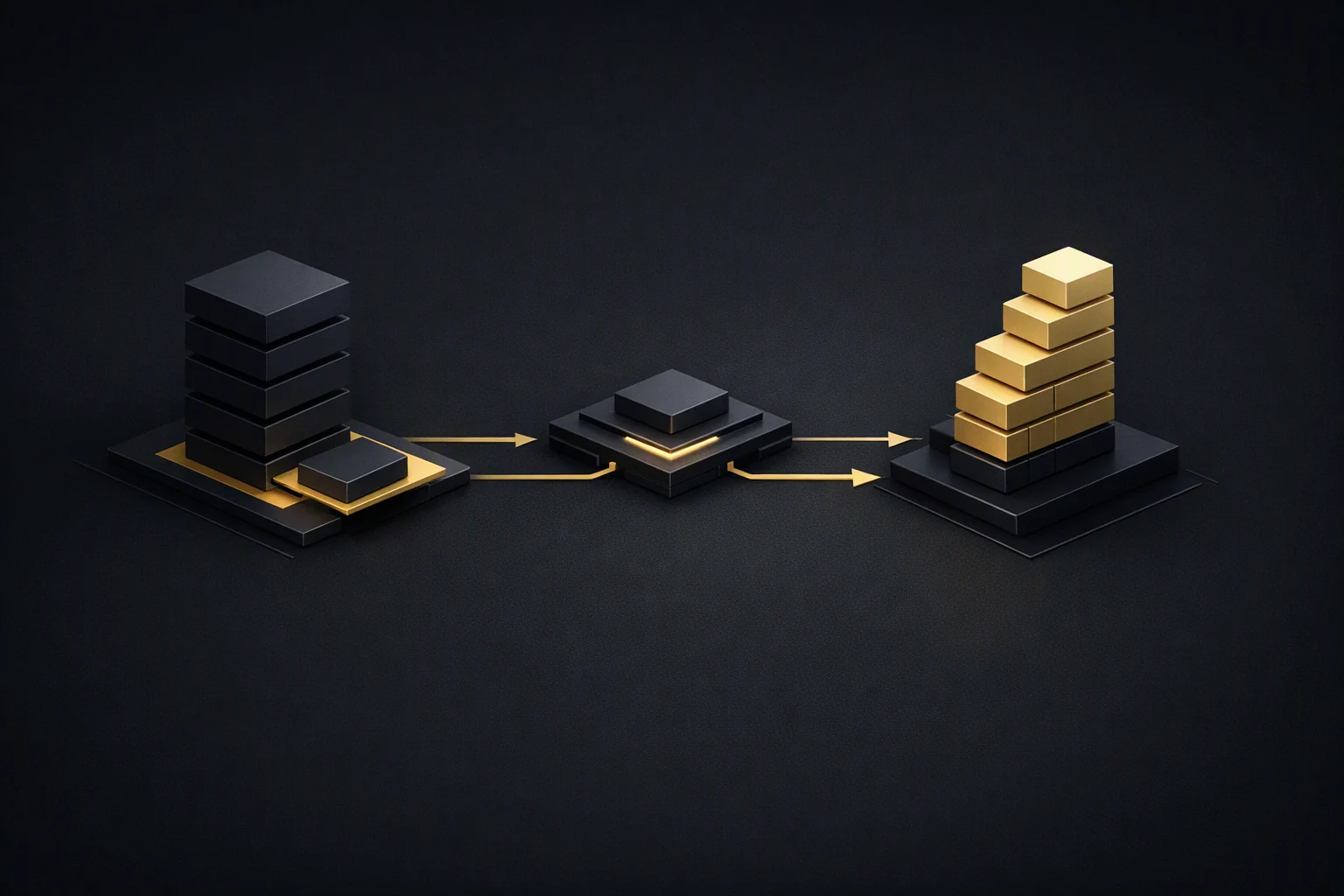
Dispatch Mode is what Block just did. You identify tasks humans perform. You determine which ones AI can handle. You dispatch the work to the machine and dispatch the human to the exit. Wall Street will write you a $7.8 billion check for it.
Convergence Mode is what should be happening instead. It's the harder path — where human expertise and AI capability fuse into something more powerful than either alone. Where a doctor doesn't get replaced by a diagnostic algorithm but becomes a physician whose clinical judgment is amplified by real-time computational intelligence. Convergence creates durable value. Dispatch just extracts it.
The real question
The question isn't whether AI will continue replacing jobs. That's settled. The $7.8 billion answer is in.
The question is whether we're going to build the infrastructure — educational, institutional, psychological — that helps people reach Convergence Mode before companies reach Dispatch Mode.
Right now, Dispatch is winning. Not because it's better for society. Because it's faster, cheaper, and Wall Street writes billion-dollar checks for it.
I'm building the other side of this equation. Not because it's easier. Because someone has to.
The math is the editorial. And the math says we're running out of time.