
Architecture
The model is not the product
Why the AI industry needs a new system category — and what a Metacognitive Reasoning Architecture actually is.
Originally published on billfaruki.substack.com on March 17, 2026. Republished on MindHYVE.ai with light canon edits.
There's a question the AI industry has been answering wrong for three years.
The question is: “How do we make AI systems smarter?”
The consensus answer has been: build bigger models. More parameters. More training data. More compute. One frontier generation after another, from every leading lab. Each generation larger, more expensive to train, and incrementally more capable.
This answer is correct for the organizations building foundation models. It is completely wrong for everyone else.
If you are deploying AI into production — into healthcare, legal, education, insurance, finance, real estate — you are not training models. You are calling them. Your entire cost structure, your latency profile, your reliability ceiling, and your competitive differentiation exist at the inference layer. You are downstream of the model providers, and the models themselves are becoming commodities.
So the real question is not “how do we build a smarter model?” It is: how do we build a smarter process that uses existing models as components?
That question leads to a fundamentally different architecture. One that the current taxonomy doesn't have a name for.
Until now.
Introducing the Metacognitive Reasoning Architecture
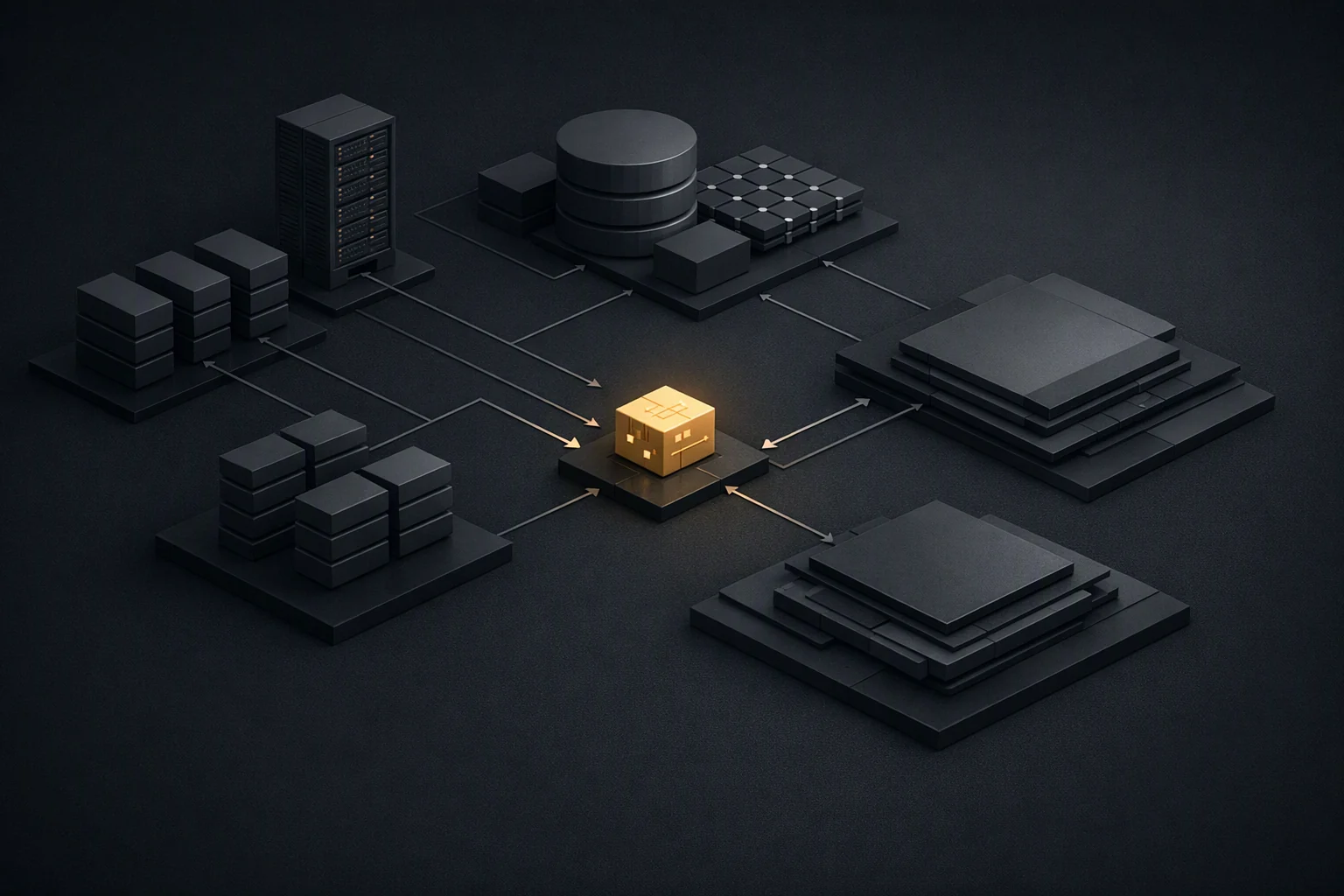
A Metacognitive Reasoning Architecture (MRA) is a new category of AI system. It sits above foundation models in the technology stack. It has zero parameters, zero training data, and generates no tokens. It cannot answer a question by itself.
What it does is reason about how to reason.
An MRA determines which models to invoke, in what configuration, how many times, how to verify their outputs against each other, when to backtrack and try a fundamentally different approach, and how to learn from the outcomes of past reasoning episodes — all without modifying a single model parameter.
The relationship between an MRA and foundation models is analogous to the relationship between an operating system and hardware. The OS doesn't perform computation directly. It determines how computational resources are structured, scheduled, and allocated to produce outcomes that no individual hardware component could achieve in isolation.
The models are the brains. The MRA is the mind.
What an MRA is not
Precision matters here. The AI landscape is cluttered with overlapping terminology, and an MRA is none of the existing categories.
It is not a large language model. An MRA has no weights, no parameters, no training corpus. If you turned off every model endpoint it orchestrates, the MRA would have nothing to work with. It is not a model. It is a system that makes models useful in ways they cannot achieve alone.
It is not a framework. LangChain, CrewAI, AutoGen — these are toolkits. They provide abstractions for chaining LLM calls. They do not make decisions. They do not adapt their behavior based on the problem at hand. They do not learn from outcomes. An MRA uses infrastructure, but it is not infrastructure.
It is not middleware. Middleware passes data between systems. An MRA makes architectural decisions in real time — which systems to invoke, in what order, how many times, and whether to throw away the results and restructure the entire computation from scratch.
It is not an ensemble. Ensembles average outputs. That's statistics. An MRA runs adversarial cross-examination between models, detects contradictions in their outputs, backtracks through recursive loops when inconsistencies are found, and has a metacognitive layer that can restructure computation mid-flight. Averaging is a rounding error compared to what this does.
It is not an agent. An agent is a model with tools. An MRA manages agents — deciding which to deploy, verifying their outputs against each other, catching when one is hallucinating, and learning over time which agents perform best on which problem types.
An MRA is something new. And we need the term because the thing it describes didn't exist before.
Why now
Two converging shifts make MRAs both possible and necessary.
The training-to-inference shift. The AI industry is moving from a training-dominated to an inference-dominated cost structure. Training runs are increasingly concentrated among a handful of organizations with the capital to spend billions on compute. For the rest of the industry — which is nearly everyone building AI products — the models are available as API calls or managed endpoints. They are commodities. When the underlying models are commodities, the differentiation layer is orchestration.
The ceiling of single-model intelligence. A frontier model, regardless of its parameter count, executes one forward pass through a fixed computational graph per token. Even chain-of-thought prompting — which has demonstrated real capability gains — is still sequential token generation within that fixed graph. The ceiling is architectural, not parametric. A single model cannot verify its own outputs reliably. It cannot explore multiple solution strategies simultaneously. It cannot backtrack mid-generation when it discovers its approach is wrong. It cannot learn from deployment experience without expensive retraining.
These are not limitations that will be solved by making models larger. They are structural limitations of the single-model paradigm. An MRA breaks through these limitations not by replacing the models but by structuring how they are used.
What an MRA actually does
The defining capabilities, in concrete terms:
Adaptive compute allocation. A single model spends the same computation on a trivial factual question as it does on a novel research-grade reasoning problem. An MRA classifies the incoming problem across multiple axes — domain, difficulty, composability, risk — and allocates compute accordingly. Trivial queries get a single model, single pass, under 200 milliseconds. Complex queries get dozens of parallel inference paths across multiple models with full adversarial verification. The compute ratio between easy and hard problems can exceed 1000:1.
Parallel heterogeneous exploration. Instead of relying on one model's perspective, an MRA runs the same problem through multiple models simultaneously. Different models have different reasoning patterns, different knowledge distributions, and different blind spots. By exploiting this diversity an MRA explores a solution space that no single forward pass can reach. If each independent path has a 70% chance of finding the correct answer, 24 parallel paths yield a 99.9999999% probability that at least one succeeds.
Adversarial verification. Rather than trusting any individual model's output, an MRA subjects every candidate solution to structured adversarial testing. One model's answer is given to a different model with the explicit instruction to find what's wrong with it. A third model constructs the strongest possible counterargument. Factual claims are verified against retrieval indices. Code is executed. Math is computed independently. What emerges is not a guess — it is a solution that has survived cross-examination.
Recursive backtracking. Autoregressive language models generate tokens left to right. They cannot go back. An MRA can. When the synthesis of sub-solutions reveals contradictions, the system returns to an earlier stage with the contradiction as new context and tries again. This is genuine backtracking — the ability to discover that an initial approach was wrong and pursue a fundamentally different one.
Metacognition. This is the defining feature — the one that gives the architecture its name. A dedicated control layer monitors the entire reasoning process in real time: Are the parallel paths converging or diverging? Is one sub-problem consuming disproportionate resources? Are the models agreeing too quickly, suggesting groupthink rather than genuine convergence? Should the system reclassify the problem, substitute a different model, or exit early because confidence has plateaued? This is reasoning about reasoning — and it is something no individual model can do about its own inference process.
Episodic learning without retraining. Every reasoning episode is recorded: what worked, what failed, which model combinations produced the best results for which problem types, which verification stages caught the most errors. Over thousands of episodes, the MRA accumulates institutional expertise that guides future decisions. After processing 10,000 medical reasoning problems, the system knows — empirically, not theoretically — which configurations work best for cardiology versus radiology versus psychiatry. This expertise lives in the orchestration layer, not in any model's parameters. It improves continuously. It costs nothing to accumulate. And it creates a compounding advantage that deepens with every inference episode.
Intelligence is structure, not scale. We've been building bigger brains. It might be time to build better minds.
The structural argument
The case for MRAs is not speculative. It follows from a straightforward observation about computation.
A frontier model performs O(N × T) computation per query: N parameters per token, T tokens generated. This is fixed. Every query gets the same computational structure.
An MRA performs O(P × M × S × V × R) computation: P parallel paths, M models, S strategies, V verification rounds, R recursion depth. This is variable. The computational structure adapts to the problem.
Even if every individual model in the MRA is smaller than the frontier model, the structured computation explores a solution space that a single forward pass cannot reach. The advantage is not in the components — it is in the structure of how the components are composed.
This is not a novel insight in other domains. In software engineering, we moved from monolithic applications to microservices decades ago — not because any individual microservice is more capable than a monolith, but because the structured composition of specialized services produces systems that are more reliable, more scalable, and more maintainable than any monolith. The same structural logic applies to AI inference.
What this means for the industry
If MRAs are a valid system category — and the structural argument is difficult to refute — then several implications follow.
Model providers and MRA operators are complementary, not competitive. Every time any frontier lab releases a better model, every MRA in the world gets better for free. The new model becomes another cognitive perspective the MRA can recruit. The model provider's R&D investment improves the MRA operator's capability at zero marginal cost.
The accumulation of episodic knowledge creates durable competitive advantage. Two companies can deploy identical MRA architectures on day one. But the company that has processed 100,000 domain-specific reasoning episodes has an empirical knowledge base that the newcomer cannot replicate without processing 100,000 episodes of their own. Time-in-market becomes a technical moat, not just a business one.
The locus of intelligence shifts from parameters to process. This is the most consequential implication. For three years, the industry has measured AI progress by parameter count and benchmark scores. MRAs suggest a different metric: the sophistication of the reasoning process that orchestrates inference. A 70-billion-parameter model inside an MRA can outperform a 700-billion-parameter model running standalone on complex problems — because the structured process compensates for what the smaller model lacks.
Intelligence is structure, not scale
We've been building bigger brains. It might be time to build better minds.
A brain is biological hardware — neurons, synapses, raw processing capacity. A mind is what emerges from the structured use of that hardware — the ability to plan, verify, backtrack, learn from experience, and reason about one's own reasoning.
The foundation model providers are building increasingly powerful brains. That work is essential and will continue. But the next frontier of AI capability may not come from making the brains larger. It may come from building the minds — the structured reasoning processes that use those brains as components.
That is what a Metacognitive Reasoning Architecture does. And that is why the category needs a name.
Editor's note
The term Metacognitive Reasoning Architecture (MRA) was introduced by HYVE Labs — MindHYVE's R&D Division — in March 2026. MindHYVE's named MRA implementation is AXIOM™, currently in active R&D as the architectural successor to the Eve-Fusion™ compound reasoning family. See the companion engineering essay, How to build a mind: the engineering behind a Metacognitive Reasoning Architecture, for the seven-layer technology stack that implements an MRA on Microsoft Azure.