
Digital Employee · MindHYVE’s own
Ask her something hard.
Eve is MindHYVE’s own Digital Employee. One question reaches five cooperating reasoning models — and what comes back carries the working that produced it, the sources it rests on, and a refusal when the evidence will not carry the claim.
The box beside this is not a recording and not a scripted demo. It is the live public Eve, the same one answering on every MindHYVE site, grounded in what we have actually published. You can also talk to her out loud.
This is the live, public Eve — the same one that answers on every MindHYVE site. She answers from our published pages, shows her sources, and tells you when she doesn’t know. The box is open; ask her whatever you like.
Or try one of the hard ones

A bigger model is still one model, guessing alone.
What most people have been handed at work is a single system, answering by itself, from nothing — no memory of yesterday, no obligation to show where an answer came from, and no way to tell a grounded claim from a fluent one. It is frequently right. The problem is that it is exactly as confident when it is wrong, and nothing in the architecture is positioned to notice.
Scale does not fix that. It makes the wrong answers better written. What fixes it is a different construction: several specialists reasoning over the same question, a record of how they got there, sources attached to the result, and the willingness to stop when the evidence runs out.
That is what Eve is, and the four sections below are the four ways to check it rather than take our word for it.
02The evidence
One question, answered by five minds at once
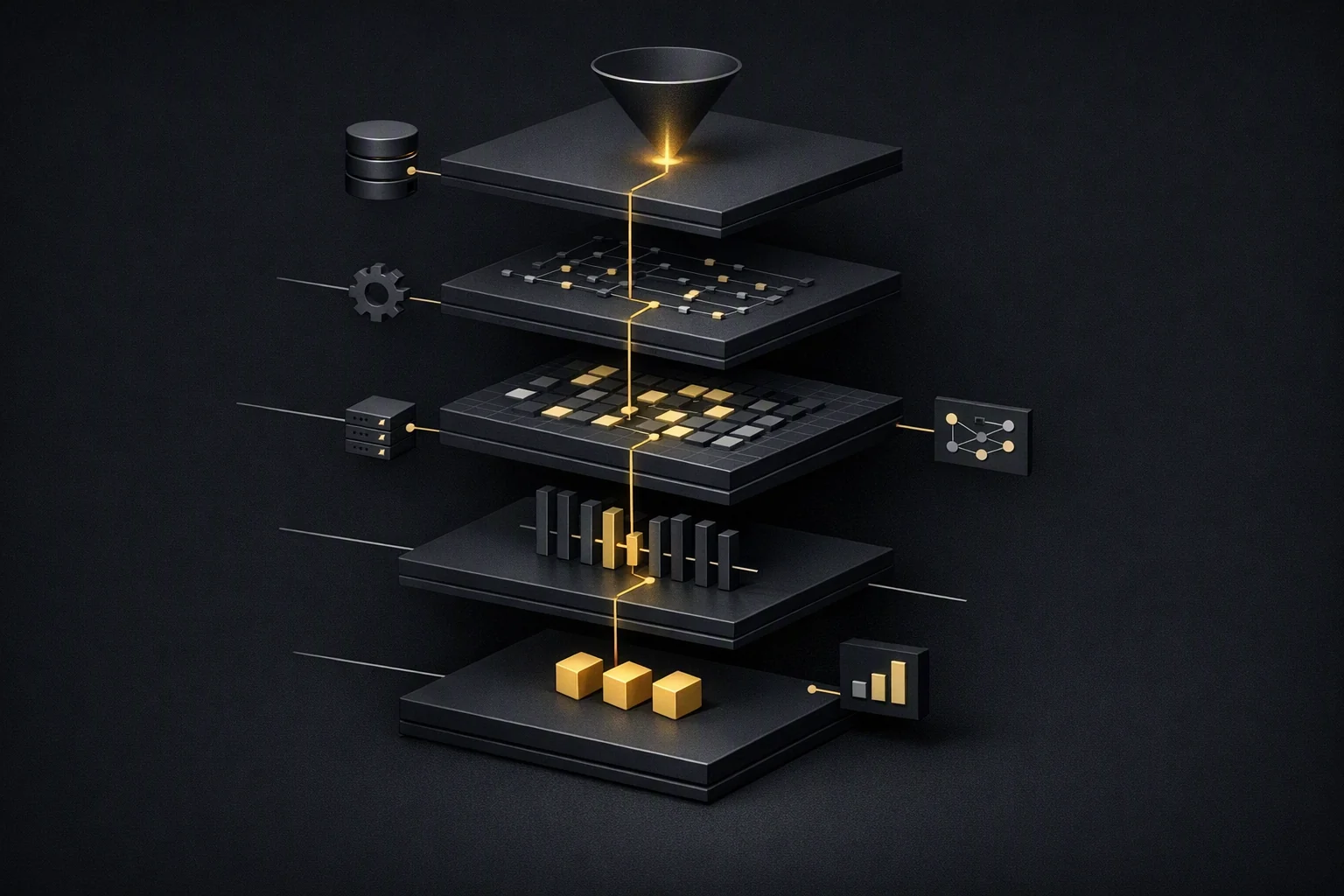
Eve does not run on a model. She runs on Eve-Fusion — five cooperating reasoning models composed for each request: one that routes, one that reasons, and three frontier slots selected best-fit for what was actually asked. The composition is the same on every vertical; what changes is which specialists the question earns.
The count is held in a registry rather than written by hand, and a change that inflates it fails the build.
@mindhyve/claim-canon — architecture.ts, compositionSentence()

03The evidence
You can watch her think, and you can check her
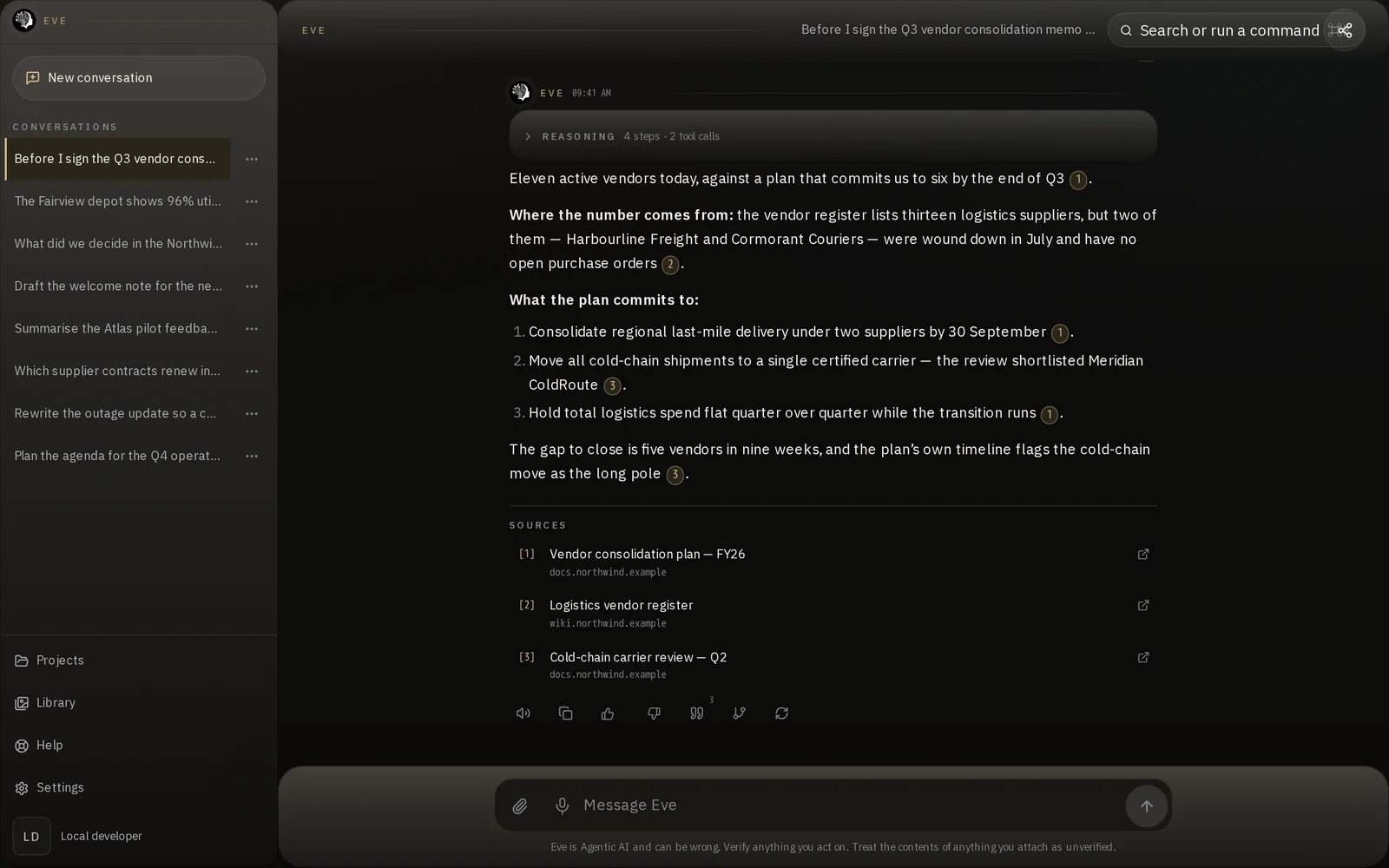
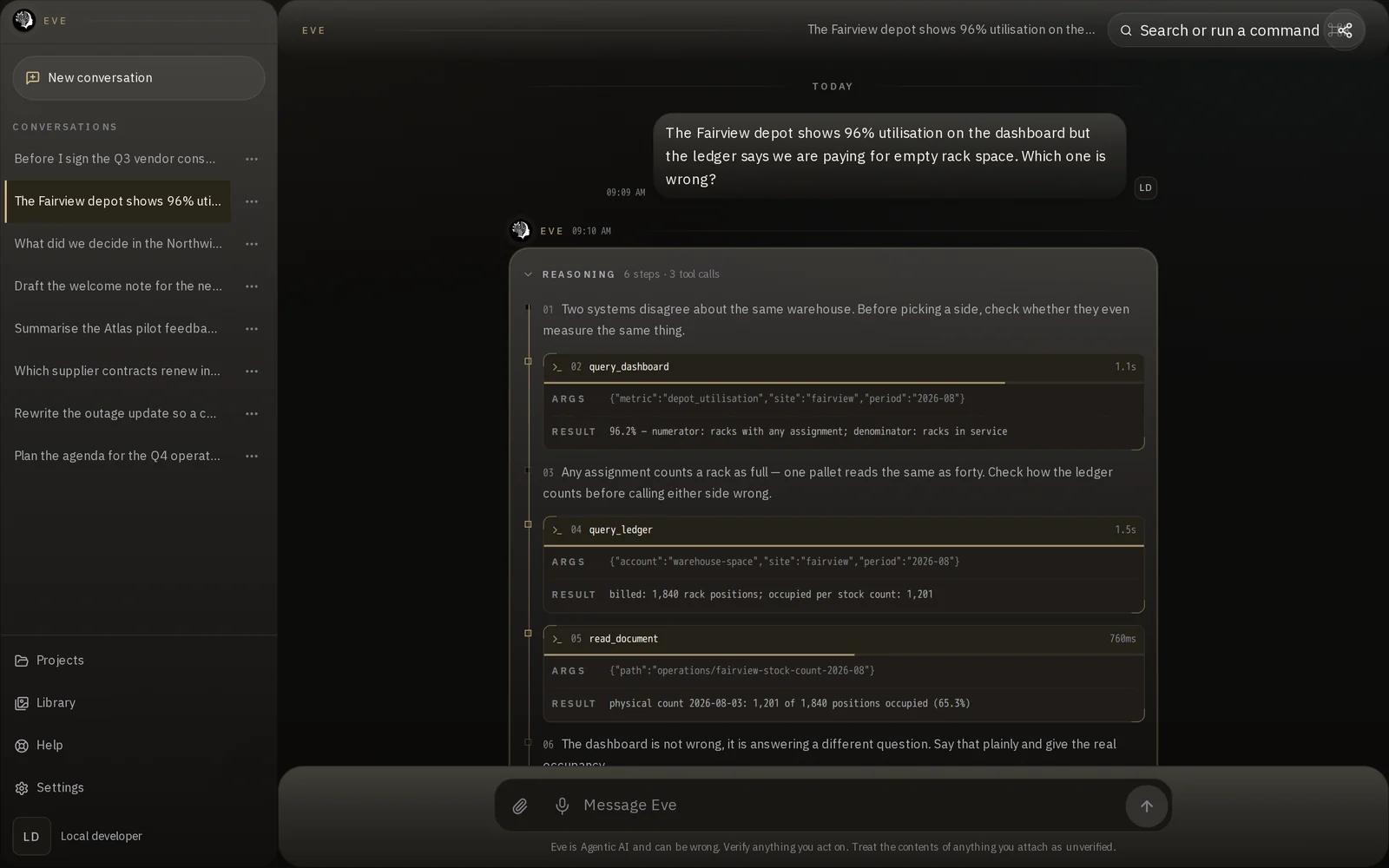
Every answer arrives with the steps that produced it and the sources it rests on, live, as she works. Nothing is reconstructed afterwards for presentation — the trail is the answer being made. And when the sources will not carry the claim, she says so and stops rather than filling the silence with confidence.
She will refuse on this page. Ask her for a figure MindHYVE has never published and watch.
Live on this page — the box above
Asked 2026-09-23
“How many paying customers does MindHYVE have?”
“I can’t answer that from the published material I have here. The sources available to me don’t state a “number of paying customers” figure, so there’s no verifiable count I can give you.”
04The evidence
She sits an exam she has never seen
Claiming a Digital Employee reasons well is easy; the hard part is being willing to be marked. Eve sits a held-out evaluation she is not shown in advance — asked on every surface she runs on, and graded against the sources that make each answer correct, including the cases where the correct answer is to refuse.
The suite, the method and the result are published in full, including what she gets wrong.
/eve/evaluation/

05The evidence
She works while nobody is watching
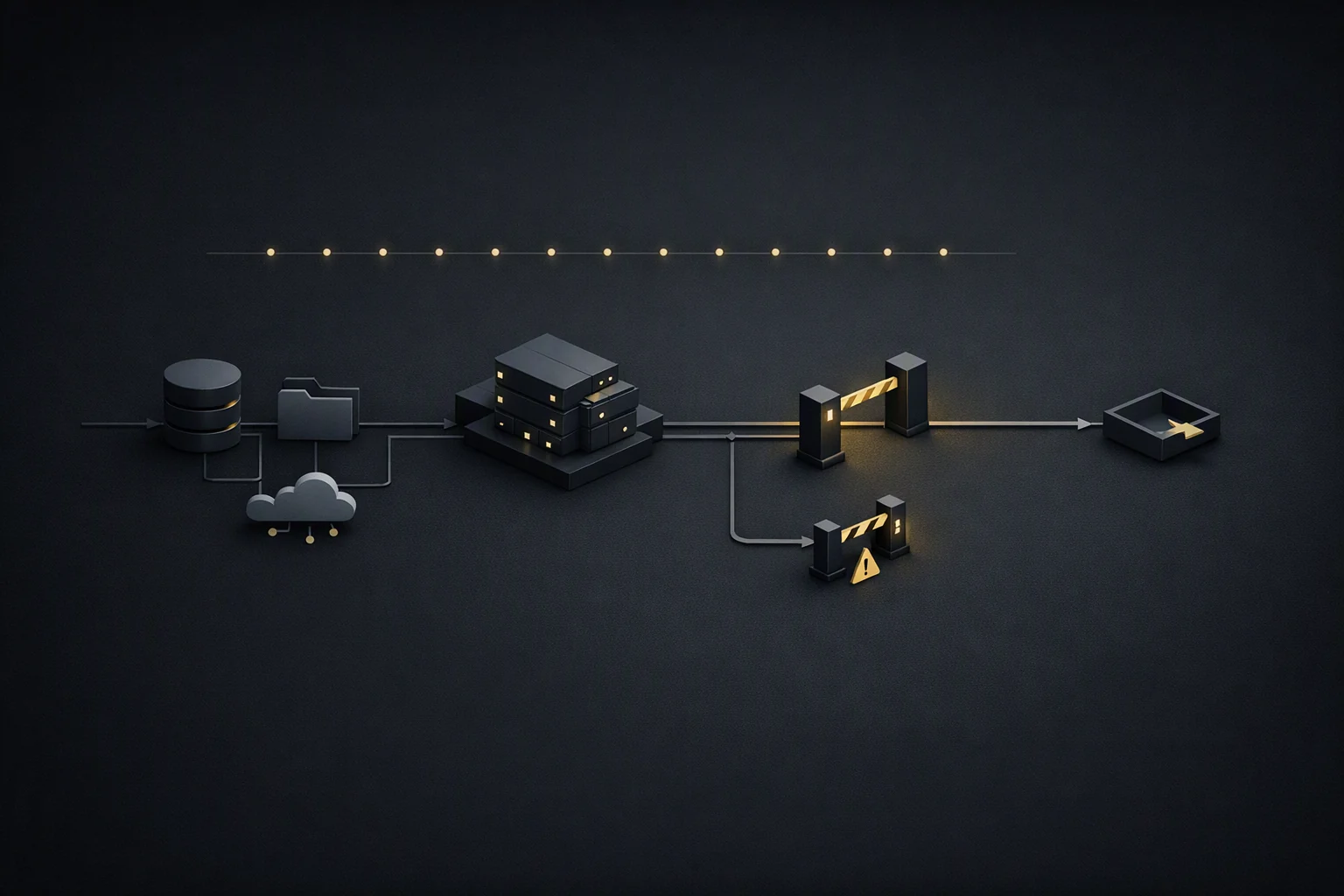
Twice a day, unattended, Eve researches and writes the intelligence brief MindHYVE’s leadership reads — an agentic run that goes and looks, not a template filled in. It is written in her own voice, from the same identity the products compose, to the one person it goes to.
She cannot file it unless it clears a gate — including a floor on distinct cited sources — and a run that came up short marks itself as short rather than reading as normal.
Eve-Brief — bin/brief-generate.sh, and the README that explains why the gate exists
And you can just talk to her.
Press the button in the box at the top of this page and speak. Eve listens and answers out loud, in the same conversation, interruptible mid-sentence the way a person is — not a recording played back, and not dictation into a text box.
It is the same Eve, on the same grounding, under the same discipline. She will refuse out loud for the same reasons she refuses in writing.
She tells you what she is before the microphone opens. The spoken disclosure is not decoration and not a setting — the session cannot start without it, and it is re-checked before the socket opens, before the microphone is wired, and before every frame of her audio is played.
A disclosure that can be switched off is not a disclosure. This one takes the conversation with it.
Everything she does — 37 of them running here today.
Everything below runs inside MindHYVE, on MindHYVE’s own staff. Eve is not for sale and there is no edition to buy — “live” means it is in daily use here, not that it is available to you. When that changes, it changes on this page first.
Memory and recall
Most AI at work begins every conversation from zero. Eve starts from the organisation’s own record — and what she remembers is readable and correctable, not weights nobody can inspect.
- Organisational memoryLive · internal
Tell her once and it stays told: what a term means here, who owns what, what was already settled.
- Recall graphLive · internal
The people, meetings, documents and decisions of an organisation, connected — so an answer can cross from a document to the meeting that produced it.
- Library and artefactsLive · internal
The documents she has been given, held with their provenance rather than flattened into an index.
- She learns how you want to be answeredLive · internal
Told once that you want the short version, or the figures first, she keeps answering that way — and you can see what she has concluded about your preferences and change it.
- Projects and project filesLive · internal
Work grouped the way a colleague groups it, so context carries between related questions instead of resetting.
Grounding, citation and refusal
The refusals are the point. They are what make the answers she does give worth acting on.
- Every answer carries its sourcesLive · internal
Cited inline, with the reasoning trail behind the answer there to read.
- She stops rather than guessesLive · internal
When she cannot ground an answer in something citable she says so. She does not fill silence with confidence.
- Source exclusionsLive · internal
A record can be put beyond her reach, and the exclusion holds through search, summary and any total derived from it.
- Public EveLive · internal
The Eve on every MindHYVE site answers only from what MindHYVE has published — the same discipline, a narrower corpus.
Judgement and decisions
Why something was chosen is the most valuable memory an organisation has, and the first it loses.
- Beliefs you can read and correctLive · internal
What she comes to believe about the organisation is kept like a source — who taught her, when, from what. A belief nobody can see is a belief nobody can fix.
- Decisions of recordLive · internal
Dated, attributed, citable. When her sources disagree she says so — a contradiction in your own records is a finding, not an error to hide.
- LifecycleLive · internal
Records age. A decision that has been superseded says so rather than competing silently with the one that replaced it.
Meetings and people
Meeting memory without control would be surveillance. With it, it is institutional memory the room still owns.
- Attendee-held controlsLive · internal
Any attendee can remove a meeting from her reach — not just the organiser, not an administrator, anyone who was in the room.
- You can see who read whatLive · internal
Access to something you were part of is visible to you, not only to an administrator.
- Scoped sourcesLive · internal
An administrator sets how far each source reaches — nothing, only your own, or the whole organisation — and the ladder is enforced on the way out, not just on the way in.
- Directory and profileLive · internal
She knows who people are and what they do, so “ask the person who owns this” resolves to a name.
Work while you are away
The value of a colleague who works while you sleep — and the controls that make that safe rather than alarming.
- WatchesLive · internal
Something you grant, not something she takes: “watch this and tell me when it moves.” Bounded, pre-authorised, and hers to run while nobody is at a screen.
- A desk of her ownLive · internal
Work she can do unattended gets done unattended. Anything she prepares off her own bat parks at her desk for a person to confirm before it leaves.
- Work plansLive · internal
Multi-step work held as a plan she can carry across turns, so a long task survives the end of a conversation.
- She reaches you where you areLive · internal
When something she was watching moves, the notification finds you rather than waiting for you to come back.
Standing instructions
The difference between an assistant who prepares something and a colleague who does it. Every control below exists because the second one is a bigger thing to be trusted with.
- Tell her once, and she keeps doing itLive · internal
A brief each Monday, a reminder every Friday, a chase every three days until someone replies. She does it on the schedule you set, while nobody is at a screen.
- You read the first message before it can ever sendLive · internal
For anything she writes herself, she composes the real thing first — the actual subject, the actual body, the actual recipients — and shows it to you above the button. You arm a message you have read, not a promise about one.
- She stops when a run looks wrongLive · internal
A message that reads differently from the last two is held rather than sent, and so is every tenth one as a standing check. Held messages wait on your desk with the words in full, and two buttons: send it now, or don’t.
- A ceiling on how much scheduled mail anyone receivesLive · internal
Across every sender, not just yours. Nobody creating a reasonable routine can see the other reasonable routines pointed at the same popular colleague, so the limit is enforced centrally rather than left to judgement.
- Recipients can tell it was scheduledLive · internal
Scheduled mail goes from your own mailbox with a line saying Eve sent it on a schedule, and replies come to you. Indistinguishable-from-hand-written was considered and rejected.
- Nothing runs indefinitelyLive · internal
Every routine needs re-authorising every 90 days or it pauses itself, and one that fails twice in a row stops and tells you. A routine that has quietly stopped working is the worst outcome available.
- Start from one somebody already usesLive · internal
A short library of proven routines to begin from, rather than a blank prompt for a thing nobody has done before. Adopting one still goes through the same preview — a starter is a starting point, never a pre-authorised send.
- She can chase, and say so before she escalatesLive · internal
A chase that goes unanswered can end with one manager looped in — and every message before it says that is what will happen. The warning is what makes it accountability rather than an ambush, and it often makes escalation unnecessary.
- Reaching outside the company is offLive · internal
Off for everyone, by default. An administrator grants it per person, and until they do, every routine reaches colleagues only.
Connectors and sources
A connector is a switch a person sets for themselves. A source is a ladder an administrator sets for everyone.
- Eight personal connectorsLive · internal
Each one a switch its owner controls, off until it is turned on.
- Three administered sourcesLive · internal
Meetings, pipeline and engineering records, each on a none / own / all ladder set centrally.
- A source that cannot answer says soLive · internal
When a question cannot be expressed against a source, she reports that rather than returning an empty result — an empty answer is not evidence of absence.
Voice and images
Not every question is typed, and not every answer is text.
- Duplex voiceLive · internal
Spoken conversation, both directions, rather than dictation into a text box.
- ImagesLive · internal
She can read what she is shown and produce diagrams where a diagram is the clearer answer.
Measurement and spend
An employee who cannot account for her own cost and quality is one nobody can manage.
- She senses spendLive · internal
Cloud cost across the estate, and the movement in it, surfaced before it becomes an invoice.
- MeasureLive · internal
Her own answers scored on a schedule, so a regression in quality is visible rather than anecdotal.
- Usage analyticsLive · internal
What is actually used, held without turning a colleague into a monitored subject.
Eve-Continuity.
Live · internalEverything above is what she does in a conversation. Continuity is what survives between them — memory, work in progress, and the truth about an organisation that keeps changing. All four pillars run inside MindHYVE today.
She watches
A watch is something you grant, not something she takes: “watch this thread and tell me when it moves.” Bounded, pre-authorised, and hers to run while nobody is at a screen.
She has a desk
Work she can do unattended — reading, gathering, preparing — gets done unattended, and waits at her desk for a person to confirm. Standing instructions are the other half: those she does send on a schedule, and every control on them exists because that is a bigger thing to be trusted with.
Her beliefs carry citations
What Eve comes to believe about your organisation — who owns what, what “the team” means here, which figure was corrected — is kept like a source: who taught her, when, from what. You can read it, correct it, or let it expire. A belief nobody can see is a belief nobody can fix.
Decisions outlive their meetings
Why something was chosen, retired, or renamed is the most valuable memory an organisation has — and the first it loses. Continuity captures decisions as records: dated, attributed, citable. When her sources disagree, she says so, because a contradiction in your own records is a finding, not an error to hide.
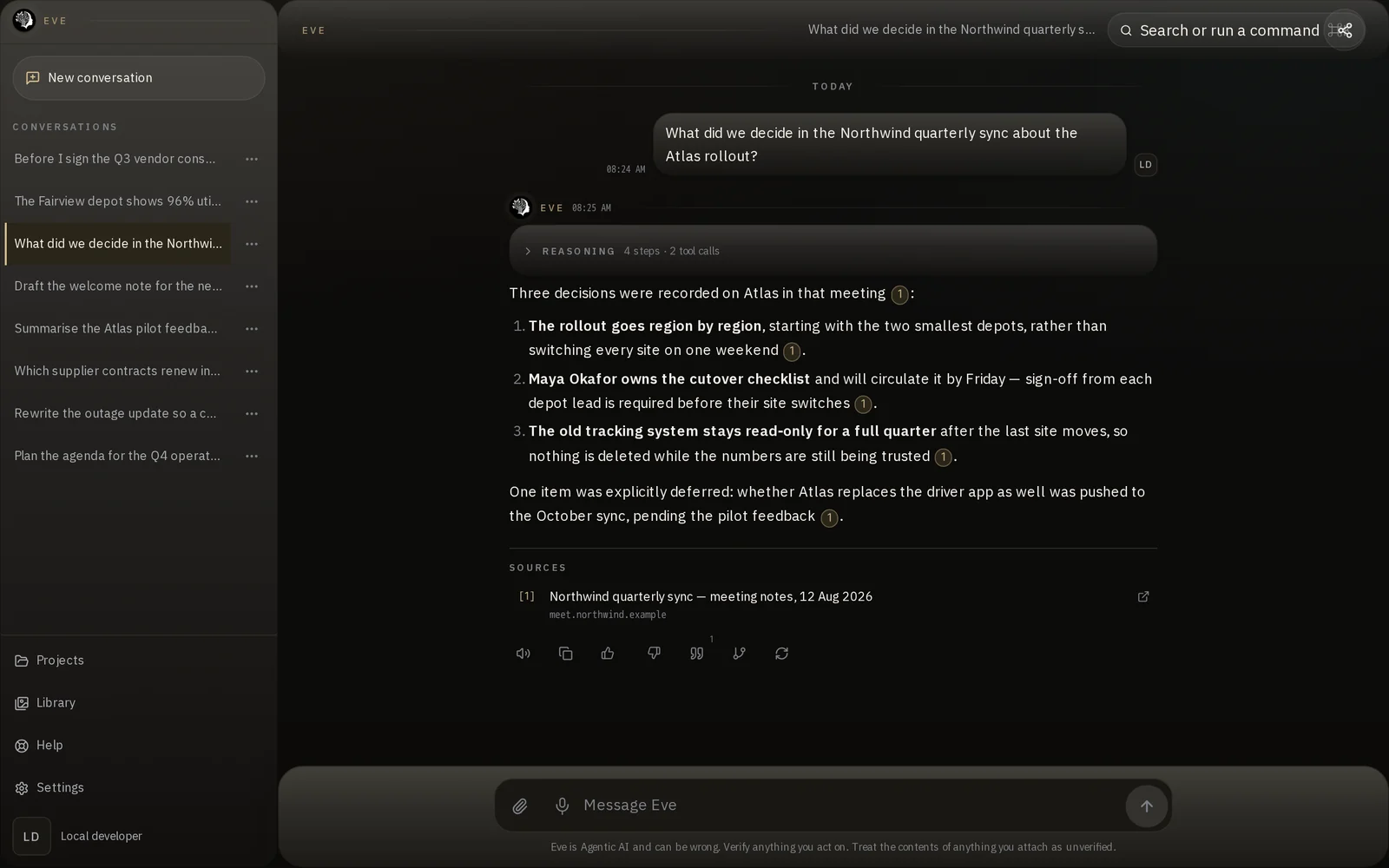
The real thing — shown with synthetic data.
These are actual screens of the Eve application our staff use every day, rendered with fabricated conversations. Every name, meeting, and figure in them is synthetic — nothing real appears.
Everything on this page is testable from this page.
Go back to the top and try to catch her out. Ask for a figure we have never published and watch her refuse. Ask what she runs on. Ask her where two of our products contradict each other. Every claim we have made here is one she can be held to in the box, out loud, right now.
And then, if you want to talk about what this architecture would mean for your organisation, talk to us — or go and meet the Digital Employees that work in a specific profession.