
A biography of Belal Kemal Faruki
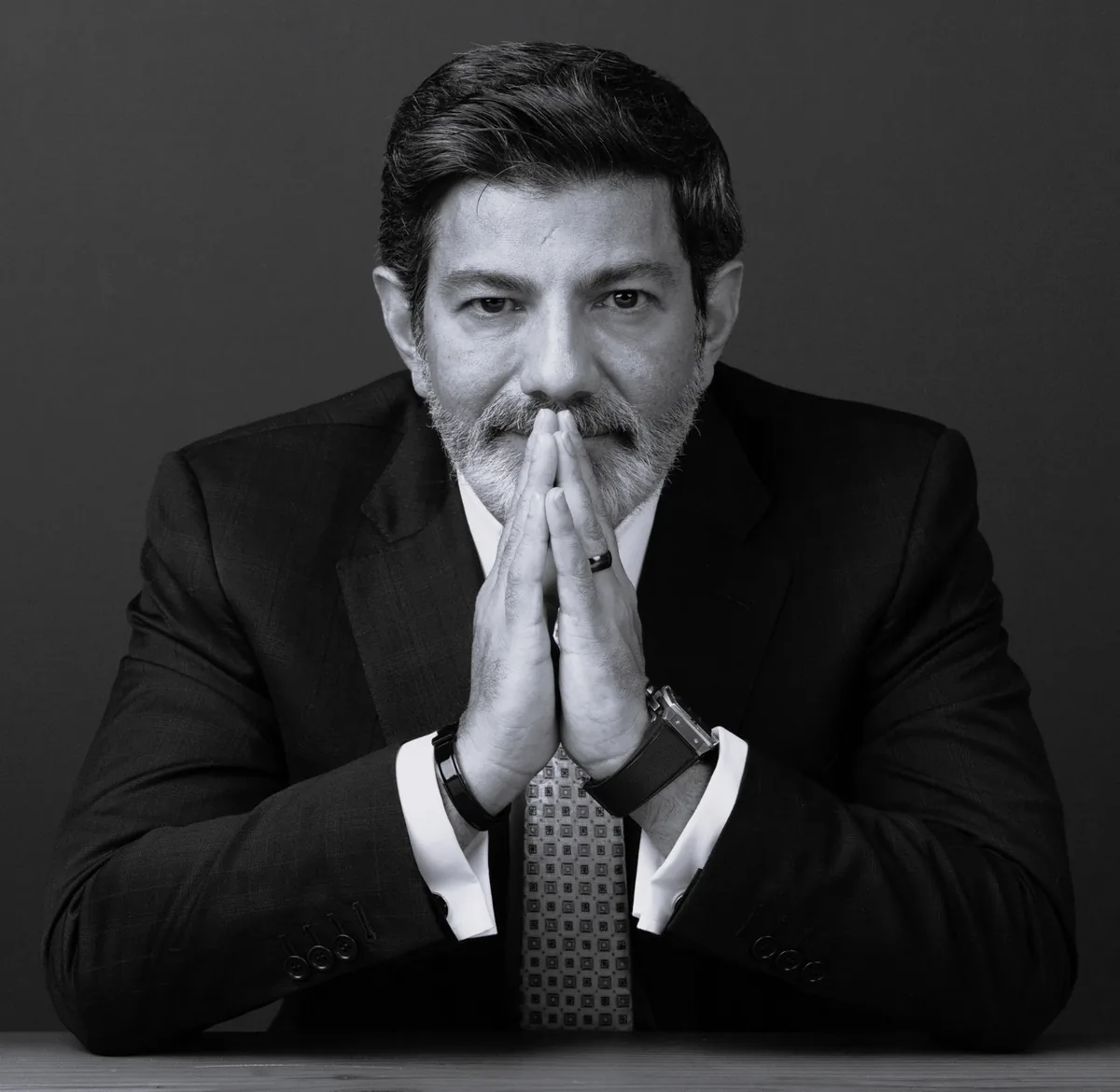
Bill Faruki.
Life, inventions and the development of MindHYVE
Belal Kemal Faruki, known professionally as Bill Faruki, is a Pakistani-American United States Army veteran, technology entrepreneur, software architect and inventor whose work spans electronic trading, enterprise software and agentic artificial intelligence. He is the founder and CEO of MindHYVE.ai and the founder of Neotick, the technology business subsequently known as DV8 Infosystems. His career connects the practical problems of financial markets with a later effort to make specialized reasoning available through software for education, healthcare, law and theological scholarship.[2, 3, 6]
His inventions include the LOGIX futures-order matching engine, the Neo family of trading and infrastructure technologies, and a jointly developed market-data and order-entry interface recorded in a United States patent application. Within the Neo family, he identifies the XNA-based three-dimensional Neostation interface and a reliable multicast messaging bus as particular technical achievements. His later work includes MindHYVE’s Eve architecture and the computational approach behind the Islamic Primary Source Corpus. These projects connect interface design, distributed communication and the organization of evidence for machine reasoning.[2, 4, 5, 6, 97]
Faruki has also developed an international public role as a speaker, educator and advocate for wider access to AI. His appearances include university lectures in Türkiye, technology and investment forums in Pakistan, conferences in Kenya and Rwanda, and an ITU summit workshop in Geneva. His leadership and companies have received recognition in business publications, while television and podcast interviews document his ideas and personal journey.[27, 30, 32, 34, 35] His community work includes charitable giving, sponsorship of Muslim institutions and educational outreach, often undertaken with his wife, Maliha.[88, 89, 90] He has served as co-chair of the Pakistan American Tech Council, working with the Pakistan Consulate in Los Angeles on technology cooperation between the two countries.[105, 106] His essays, policy discussions and technical papers develop a parallel public record of his thinking about AI access, human judgment and the design of reasoning systems.[111, 112, 113]
Early life and the move to the United States
Faruki has given his birth date as December 12, 1971. Born and raised in Karachi, Pakistan, he moved to the United States in 1991.[1, 2, 3]
In a 2025 Tech Destination Pakistan interview, he recalled beginning American life with little money, living with relatives in Culver City and taking the bus to a blood-bank laboratory job. He later sold computers at Circuit City, drawing on his early interest in personal computing.[26]
Service in the United States Army
From 1992 to 1995, Faruki served in the United States Army at Fort Sill, Oklahoma. His published biography identifies his military specialty as 13B, field artillery. He entered the Army the year after moving to the United States, making service in uniform an early and significant chapter of his American life. His military service preceded his career in financial technology and the companies he would later build.[1, 2]
Looking back in the same interview, Faruki described Army service as central to his sense of becoming American. Training and living alongside soldiers from different states gave him a daily immersion in American life. He recalled completing his basic and advanced artillery training at Fort Sill.[26]
Learning to build software
Faruki left university to pursue entrepreneurship and began teaching himself to program in 1996–1997.[1, 2]
Faruki’s account of becoming a developer begins with a business problem. Working in financial services, he wanted customers to have better electronic access to market and account information. He learned to build software to address that need. This makes his early technical development closely connected to the work of brokers and traders: access to information, usable interfaces and the movement of orders were immediate operating concerns.[2]
Trading technology and the Neo inventions
His professional chronology places him at LimitUp Trading as president from 1998 to 2000, followed by a chief technology officer role at Daniels Trading in 2000–2001. It then records work as a principal architect at a Microsoft subsidiary from 2001 to 2005, covering architecture, development, project management and solutions for financial services and insurance.[1]
Faruki identifies LOGIX, the LimitUp Online General Information Exchange, as an early invention associated with the LimitUp period. He describes it as a matching engine for electronically matching orders in futures contracts. A matching engine is the part of an electronic marketplace that pairs compatible buying and selling orders. The account places LOGIX among his earliest efforts to build the machinery of electronic trading.[2]
Faruki founded Neotick in 2006. His contemporary blog identifies him as its founder, chief technology officer and chief architect, while also signing posts as CEO. Its description places the business in capital-markets research, consulting and software development, particularly for smaller and growing financial organizations. It records experience across brokers, exchanges, hedge funds, proprietary trading firms and software businesses.[7]
At Neotick, he developed a related family of products addressing different parts of electronic trading. Faruki has confirmed his inventorship of the recovered Neo products. Neotick’s archived website supplies contemporary descriptions of their functions.[2, 4]
Neostation was the trading and order-execution platform. Neopipe, also called Neopipes, provided exchange connectivity and protocol conversion. Neotronic exposed market access through an application programming interface. NeoFIX supported communication using the FIX messaging standard. Neobus provided publish-and-subscribe messaging between services. Neorisk addressed monitoring and management of trading risk before and after execution. These components covered the trader’s screen, the communication between systems, access to exchanges and oversight of trading activity.[4]
NeoModel provided a reusable, modular framework for building trading and infrastructure systems. The Neo family evolved over time: the earlier catalogue presented Neopipe as protocol-conversion software, while the later website described Neopipes as hosted exchange connectivity. This combination linked software components to the network services needed to operate them.[4, 8, 9]
Neostation and three dimensional trading
Neostation Gen V brought game-development technology into a trading workstation. In a website capture dated February 1, 2011, Neotick describes building it with Microsoft .NET and XNA. Traders could position price ladders and animated graphs inside a three-dimensional workspace. The stated purpose was to make more effective use of screen space while displaying rapidly changing market information. The company also described separating the demands of screen updates from the computing needed for execution, claiming capacity for hundreds of thousands of market-data updates per second and execution below one millisecond. Faruki identifies the XNA interface as his invention. The architecture addressed both how traders organized information and how the workstation remained responsive under load.[9, 97]
Reliable messaging and execution infrastructure
Faruki describes another Neotick invention as a reliable multicast messaging bus: one publisher could distribute messages to many receivers while maintaining their order and guaranteeing delivery, with reported delivery latency below 100 microseconds, or one tenth of a millisecond. The engineering objective combined rapid distribution with a dependable sequence of events across participating systems. Those are distinct requirements: receiving a message quickly is insufficient if a receiver misses an earlier update or processes events in the wrong order. Faruki’s account supplies the multicast, delivery-guarantee and latency specifications.[97]
Contemporary materials establish the messaging product’s place in Neotick’s architecture. The December 2007 catalogue names Neobus as a scalable publish-and-subscribe bus for communication between loosely coupled services. The later Neotronic description places a proprietary bus inside the execution platform and describes dynamically selecting a less congested path, with fault tolerance built into the design. These descriptions connect the messaging work to Neotick’s broader effort to reduce execution delays.[4, 9]
Faruki also identifies Neogrid among his inventions. Later Neotick materials describe a Core Framework SDK and a Capital Markets SDK, showing the company’s continuing interest in reusable software foundations. Those materials also broaden the company’s stated work beyond finance into other enterprise sectors.[2, 10]
Neotick’s presence in the trading industry is corroborated by an exchange document. In March 2008, ICE Futures U.S. listed Neotick among independent software vendors through which participants could access its Russell index futures contracts electronically.[11]
A separate public record documents Faruki’s role as a co-inventor. United States application US20070150401A1, filed December 23, 2005 and published June 28, 2007, names Belal Faruki and Steven Brucato for “Graphical user interface and method for displaying market data and entering trading orders.” The application describes ways to present changing bids, offers and prices and enter orders through specialized graphical displays. Its design addresses the difficulty of keeping useful market information visible as prices move. Google Patents records its status as abandoned.[5]
Neural Markets and legal proceedings
Faruki’s financial career also included Neural Markets, LLC, an investment adviser that he operated and majority-owned during 2010–2011. It managed the Evolution Quantitative 1X Fund. Proceedings concerning representations made to prospective investors became a significant chapter in his career.[12]
An SEC order dated May 17, 2012 barred Faruki from association with investment advisers, brokers, dealers and several other specified categories of regulated financial organizations. The order followed an April 2012 permanent injunction. He consented to the administrative order without admitting or denying its findings, except for jurisdiction and the specified finding concerning the injunction.[12]
The subsequent criminal proceedings had a different outcome and legal basis. According to the United States Court of Appeals for the Seventh Circuit, a jury convicted Faruki of wire fraud on January 17, 2014 in connection with the investment scheme, and the district court sentenced him to 48 months in prison. He appealed on the sufficiency of the evidence and two evidentiary rulings. The Seventh Circuit affirmed on October 13, 2015.[13]
Faruki takes particular pride in building a highly successful entrepreneurial career without completing college, and in achieving that success despite his past legal setbacks.[2]
Enterprise software and the emergence of MindHYVE
Neotick later became DV8 Infosystems; the company’s published chronology dates the rebranding to 2020. The business broadened into enterprise technology, custom development, cloud architecture and AI integration. In an October 2024 interview, Faruki described its work in automation, cybersecurity and machine learning, and presented HYVE Labs as a place for experimentation within that broader engineering business.[1, 14]
The same interview gives a direct account of his preferred management approach. He described a relatively flat organization in which engineers could contribute ideas and collaborate on experimental projects. His emphasis was on connecting technical development to a client’s operating needs.[14]
MindHYVE’s research origins date to summer 2022, when Faruki began HYVE Labs. The company describes the original idea as intelligence assembled from cooperating models with different cognitive roles. Its founding account explains HYVE as “Hyper Yielding Vectorized Entity” and traces the MindHYVE name to Faruki’s observation that he held several working models of a business in mind at once. That observation became a metaphor for the architecture he wanted to build.[15]
MindHYVE’s published corporate timeline distinguishes this research beginning from the formation of MindHYVE.ai, Inc. on July 24, 2024. HYVE Labs subsequently became its research and development division. The business is headquartered in Newport Beach, California, with company materials identifying additional operating teams in Islamabad and Nairobi.[15, 25]
Faruki describes the purpose of the company through the idea of equalization. In a May 2025 Business Recorder interview, he argued that access to healthcare, education and legal services should extend beyond affluent communities and major cities. The same interview described a proposed $22 million investment in Pakistan, to be deployed in phases as operations and performance justified expansion.[3]
Reasoning systems and specialized AI products
Faruki’s principal technical work at MindHYVE concerns how models, training material and professional workflows fit together. Company materials identify him as the founding architect of the ArthurAI, ChironAI, JustineAI and TheoAI product family, with responsibility for engineering, product direction and partnerships.[6]
Eve-Genesis is the company’s synthetic reasoning corpus and training methodology. Its published origin story begins with riddles. Faruki’s daughter, then an undergraduate, recognized formal categories of reasoning in the material, including deduction, induction and abduction. The company says this helped clarify a method that records how a conclusion is reached, including the cognitive operation and alternatives considered. The account connects Faruki’s interest in software construction with an interest in the structure of reasoning itself.[16]
Eve-Fusion is the architecture that combines those reasoning resources with other models. MindHYVE describes a composition of five cooperating models: a routing classifier, a small reasoning model fine-tuned on an Eve-Genesis edition, and three commercially available frontier models selected for the task. The proposed advantage lies in arranging complementary capabilities around a domain’s work.[17]
Eve is the coordinating digital employee in that system. Company documentation identifies her as the first digital employee Faruki brought online and describes her role in delegating work, coordinating specialized agents and maintaining shared context. Eve-Grid provides the Azure-based infrastructure supporting the product family. Together, these names describe different layers of the system: training material, model composition, coordination and deployment infrastructure.[18, 25]
ArthurAI applies the architecture to education and learning, with editions for schools, universities, vocational programs, employers, families and individual learners. ChironAI addresses healthcare work, JustineAI legal practice, and TheoAI theological research and scholarship. The wider company portfolio also includes EliAI for financial work.[6, 15, 19]
Faruki’s published writing also explains limits on what these systems should do. In a May 2026 essay, he described “bounded agency”: software can organize and perform cognitive work inside a defined workflow while a qualified professional retains authority over consequential outputs. In the legal example, the system is not supposed to file, advise or sign automatically. This is an explicit design position in his later work, linking useful automation with professional responsibility.[21]
Computational hadith analysis and IPSC
Faruki identifies the computational approach behind the Islamic Primary Source Corpus, or IPSC, as another of his inventions. In introducing it publicly, he described work that he and his team had undertaken to make the evidence used in hadith scholarship accessible to computation. His account emphasizes connecting transmission chains, resolving narrators across collections and retaining enough information for a conclusion to be inspected and challenged. The contribution he describes is an engineered representation of scholarly evidence, incorporating the relationships and assessments on which a researcher’s judgment depends.[97, 103]
IPSC organizes hadith into a body text, or matn, and a chain of transmission, or isnad. It links the people in those chains to rijal literature, the biographical and critical assessments of narrators. Its published data specification describes the narration records, with separate datasets for narrators, hidden defects, textual clusters and aggregated teachings. A record can expose the weakest narrator, continuity assessment, supporting chains, confidence and correction history. The structure lets a researcher examine the inputs behind a grade and compare related transmissions.[101]
Narrator identity is a central problem in the methodology. IPSC normalizes Arabic names and uses canonical person identifiers, teacher–student relationships, contextual names and genealogical references to distinguish people. Unresolved identities remain explicit gaps. Its twelve-tier reliability scheme draws on classical assessments, with Ibn Hajar’s Taqrib al-Tahdhib given priority. A graph supplies relational evidence for interpreting a name within a particular transmission chain.[98]
Grading applies a computational version of Ibn al-Salah’s five conditions: continuity, narrator uprightness, precision, absence of anomaly and absence of hidden defect. The weakest narrator establishes a starting grade, adjusted for continuity and other evidence. Corroboration requires chains that do not share a common bottleneck narrator; repeated appearances of the same dependent route cannot simply accumulate as independent support. The methodology also considers ambiguous transmission formulas, known narrator deterioration and links to hidden-defect records. At least half of a chain’s narrator positions must be resolved before grading. For a record containing a chain-switch marker, the published engine grades the primary chain and records the secondary branch.[98]
The Evidence Map extends the work from an individual chain to a statement and its transmissions across collections. MindHYVE describes assembling the available chains with narrator positions, confidence and the classical critics’ original assessments. It preserves assessments by source so that different authorities’ judgments remain distinguishable. The architecture separates confidence in an individual chain, constrained by its weakest link, from assessment of the statement across corroborating evidence. That arrangement gives a researcher a way to compare support and disagreement without losing the source of each judgment.[20]
Textual analysis adds another set of checks. The release history describes an initial deterministic scan followed by progressively deeper model analysis of flagged material. The checks look for potential anachronisms, fabrication patterns, contradictions and conflicts between a strong-looking chain and a problematic text. Later releases rebuilt embeddings from corrected texts and added resolution of references involving multiple narrators. The June 2026 version 4 release packaged the corpus into public, research and scholar indexes on Azure AI Search. These changes show the work extending from algorithms into data correction, deployment and access for different research needs.[100]
The provenance disclosure specifies how that work is produced. Streaming software processes OpenITI digital editions; Eve-Theology F5/reasoner and other models assist with tasks such as identity tiebreaking, failed text extraction and difficult flagged passages. Model-assisted decisions retain provenance markers. Human contributions include architecture, thresholds, regression policy and sample audits. The project describes itself as applied AI and data engineering grounded in classical scholarship, with further scholar collaboration required. It does not claim that every narrator and chain has received individual scholarly verification or that its source texts have been collated against original manuscripts.[99]
The published quality process includes adversarial tests, regression checks and systematic audits of narrator identity, chronology and contradictory assessments. Corrections are supposed to point to a named classical authority or a precise bibliographical reference. The quality page also identifies unresolved classification and corroboration cases. This public correction process forms part of the system’s engineering: the records retain both the result and evidence that allows a later reviewer to question or revise it.[102]
Education and institutional engagement
Faruki is also associated with the California Institute of Artificial Intelligence, or CIAI, as its founder and chairman. CIAI’s AI Professional 360 program, formerly called the Dawn Directive, is presented as professional training in applied and agentic AI, delivered through ArthurAI. Its curriculum includes practical AI use, prompting, workflow orchestration and responsible application. CIAI’s educational program and MindHYVE’s delivery platform are distinct offerings.[1, 22]
In 2025, Faruki introduced ImpactHYVE in a public launch presentation. MindHYVE described the initiative as project-based learning that would connect young people with agentic AI, venture prototyping and startup work. The proposal extended his interest in practical education into a program intended to help participants develop projects and businesses of their own.[74]
Faruki’s institutional work also extended into AI policy. In a June 12, 2025 announcement, the Kenya ICT Action Network, KICTANet, reported a memorandum of understanding with MindHYVE.ai and DV8 Infosystems to support development of Kenya’s national AI policy. Its photograph identifies Faruki and KICTANet CEO Dr. Grace Githaiga signing the agreement in Nairobi. The partners proposed technical, ethical and regulatory contributions, consultation with underrepresented groups and a policy framework for submission to the Kenyan government. The agreement connected his companies’ technical work with a local organization’s expertise in digital policy and public participation.[109]
His educational outreach also included a September 21, 2025 visit to Mediatiz Foundation’s AI Mind Lab in Islamabad. The foundation reported that he met its AI and robotics team to discuss preparing learners to work with evolving technologies and making those opportunities relevant to Pakistan. Its account describes a hosted exchange with the team.[63]
At the AI SkillBridge bootcamp in Pakistan, Faruki taught a session on agentic AI, human agency and the responsibilities of people directing intelligent systems. One participant described his emphasis on ethics, intent and the shift toward designing and governing AI-supported work. Another attendee recalled a four-hour conversation that included ArthurAI and the gap between conventional coursework and practical skills. Their accounts show his teaching reaching learners directly, alongside his institutional and conference work.[82, 83]
His educational work also reaches students outside conventional university pathways. In September 2025, MindHYVE announced a collaboration with Miracle University, a nonprofit private high school in Sacramento serving young people at risk of dropping out. The announcement credited California State Treasurer Fiona Ma with bringing the organizations together and proposed using ArthurAI to support personalized learning, mentoring and educator insight.[48]
At the school’s “Multiply the Miracle” community fundraiser, Faruki led a two-hour interactive session about AI, career possibilities and ways students could connect their interests with emerging technology. MindHYVE’s January 2026 account describes conversations with students whose education had been disrupted by housing insecurity, foster care and other difficulties. The visit connected his advocacy for access to technology with students seeking another route into education and work.[49]
In March 2026, MindHYVE and California Northstate University announced a Strategic Collaboration Framework to bring ArthurAI into the university’s College of Pharmacy. The announcement linked professional education with preparation for AI-assisted work. It provides a specific example of the institutional applications Faruki has sought for the company’s technology.[24]
Philanthropy and community service
Faruki’s philanthropic interests encompass religious institutions, education, humanitarian work and community development. The donor history supplied for this biography identifies him as a major contributor to the Islamic Institute of Orange County, the Meridian Qube project, the Institute of Knowledge in Diamond Bar and ISLAH LA. It also identifies substantial support for the Rahma Center in Lake Forest, the Islamic Shura Council of Southern California in Fullerton, the Islamic Center of Yorba Linda and the Islamic Society of Orange County.[88]
The same account names Miracle University in Sacramento, Islamic Development & Empowerment in America and the Malcolm X and Dr. Betty Shabazz Memorial and Educational Center among the organizations he supports. Islamic Development & Empowerment in America, known as IDEA, is the organization previously called Islamic Relief USA; it announced its new name in September 2026. Together, these recipients show the range of causes identified in his philanthropic account, from local institutions to educational opportunity, humanitarian assistance and cultural remembrance.[88, 94]
A public acknowledgment provides a specific example of financial giving to Miracle University. Writing after a graduation ceremony for 82 students, an events professional thanked “Maliha & Bill Hasan at MindHYVE.ai” for a donation. The post uses Hasan as the couple’s surname and tags MindHYVE, linking the acknowledgment to Bill and Maliha through their names and company affiliation. The reported joint gift adds a financial dimension to the school relationship, alongside the later ArthurAI collaboration and Faruki’s direct teaching and mentoring at its “Multiply the Miracle” fundraiser.[48, 49, 89]
His support for the Shura Council is documented through both personal and company acknowledgments. The American Muslim Community Foundation identified Belal (Bill) Faruki as the event sponsor in its account of the council’s 31st Annual Banquet at Meridian Qube. The council’s own June 12, 2026 newsletter lists MindHYVE.ai as the Diamond sponsor of the June 6 gathering. Faruki also presented TheoAI at the banquet. This combination of sponsorship and participation placed him in an active supporting role at a major gathering of Southern California Muslim institutions.[67, 76, 90, 96]
Public posts also acknowledge Bill and Maliha’s support for ISLAH LA. In sharing an account of the organization’s annual gala, a supporter thanked Belal Faruki and Maliha Hasan-Faruki, together with other supporters, for helping its work with underserved communities. The acknowledgment records their involvement without specifying the amount of their contribution.[91]
Faruki has also written about attending an event supporting the Malcolm X and Dr. Betty Shabazz Memorial and Educational Center, where he met Ilyasah Shabazz, Malcolm X’s daughter. His account emphasized preserving history, education and ethical responsibility. This public appearance supplies context for the Shabazz Center support identified in the donor history.[88, 92]
His outreach has an international educational component. On May 13, 2025, Alkhidmat Foundation Pakistan reported a visit by a MindHYVE delegation led by Belal Faruki to its president, Dr. Hafeezur Rehman, in Peshawar. The discussions explored AI and digital education through the foundation’s Bano Qabil skills program. The recipient organization’s account documents an effort to develop a technology partnership for young people; it does not state a personal donation amount.[95]
Faruki also describes the contribution of time and expertise as part of this work. In a public LinkedIn comment, he said that until then neither he nor MindHYVE colleagues had charged for their AI speaking engagements, that they had collectively contributed hundreds of hours to educating audiences, and that some engagements were accompanied by philanthropic donations. His account connects that unpaid public teaching with financial support for the communities and institutions hosting it.[93]
Pakistan American institutions and technology cooperation
Faruki served as co-chair of the Pakistan American Tech Council, also known as PAKAM-Tech or PTC, during its formation in 2024. The council’s September 18, 2024 press release names him as “Bilal Farooqi” among the leaders at its inaugural meeting in the community hall of the Consulate General of Pakistan in Los Angeles. It identifies the consulate and council as collaborators in organizing the meeting and credits the Pakistan American Chamber of Commerce with a central role. Faruki’s own public account identifies him as co-chairman and describes convening a meeting with Consul General Asim Ali Khan and fellow council members.[105, 106]
At the inaugural meeting, Faruki spoke about the importance of artificial intelligence and the need to develop Pakistan’s capacity to use it. The council’s English and Urdu releases both record his contribution; an OPTV Global report published on September 18 also names him among the participants. The initiative sought to connect Pakistani-American expertise and businesses with opportunities in Pakistan, including technology investment, IT exports and employment. Faruki’s account identifies AI, cybersecurity and digital transformation as priorities for cooperation. This gave his advocacy an institutional setting in which business leaders and diplomatic representatives could develop projects together.[105, 106, 107]
The inaugural meeting also discussed a technology convention planned for November 10 in the Bay Area. The consulate’s subsequent invitation identifies that event as the Pak-USA Tech Investment Conference, held at the Stanford Faculty Club on November 10, 2024. Independent Urdu’s reporting places Faruki at the conference and records his optimism about the response and the longer-term results of the initiative. He discussed AI applications in healthcare and law, as well as ways the technology could help people in remote areas develop livelihoods. The same report identifies Asim Ali Khan as host and includes remarks from Pakistan’s ambassador to the United States, Rizwan Saeed Sheikh. The conference brought his technology advocacy into a forum supported by Pakistan’s diplomatic mission and Pakistani-American business networks.[108, 110]
Faruki also reports wider collaboration with Pakistan’s Embassy in Washington, D.C., and other Pakistani-American organizations, alongside his work with the Los Angeles consulate.[104]
International speaking and public leadership
Faruki’s public speaking has brought his work before audiences in medicine, education, government and entrepreneurship. The available programs and recordings show a progression from explaining AI applications to discussing how institutions and countries might use them. His recurring concerns are access to expertise, professional capability, local control of technology and the economic opportunities that AI could create.
His documented conference participation predates MindHYVE. On November 20, 2020, he joined Callbox Huddle’s virtual panel on choosing technology for business improvement. Callbox’s subsequent report identified him as DV8 Infosystems’ chief technology officer and described the panel’s discussion of customer relationships, business models and the transition toward technology-led operations.[55]
Callbox subsequently named him in the speaker lineup for Huddle 2023, its online event scheduled for November 9, 2023. The organizer introduced him as DV8’s CEO and invited participants to hear about business transformation and the experience of building technology ventures. Faruki shared the announcement and welcomed the opportunity to discuss his entrepreneurial journey.[79]
At APPNA’s Fall Meeting in San Antonio on September 28, 2024, Faruki delivered a keynote on AI in medical practice. APPNA’s November newsletter identifies him as the speaker on harnessing advanced AI to modernise practice operations. Its account describes a presentation on clinical workflows, practice management, revenue-cycle operations and patient care. The newsletter also names him as a participant in the meeting’s formal press conference with APPNA leaders, corroborating the October 5 Urdu report in Weekly News Pakistan.[56, 57, 81]
He also helped lead discussions at the DV8 Infosystems and MindHYVE Horizon Conclave in San Antonio in fall 2024. The company’s event video described Faruki and its leadership team discussing AI and its implications for industry. This was a separate company forum from the APPNA physicians’ gathering.[58]
In 2024, he lectured on AI and its healthcare applications at a physicians’ conference at İstinye University in Istanbul. A post by host Ayşegül Başer welcomed him and Dr. Sana Khan to the conference, while Faruki’s own account described the lectures and discussions with academic and hospital leaders. The conference addressed the challenges and opportunities of AI in medicine.[44, 45]
On October 17, 2024, Dow University of Health Sciences in Karachi hosted him at its international forum on emerging technologies in healthcare education and patient care. The university’s report names Faruki, Dr. Sana Khan and Dr. Saima Anis as speakers addressing its senior leadership, with Dr. Sohail Rao moderating. This engagement brought his ideas about medical AI before a university audience in the city where he grew up.[46]
On November 2, 2024, Faruki and Dr. Sana Khan delivered a one-hour continuing medical education lecture at the APPNA Southern California Chapter’s Annual Gala in Anaheim. The chapter president’s report records the subject as AI in medical practice and places the gathering at Delta Hotels, with approximately 200 guests. This was a further physician-education engagement following the San Antonio meeting.[80]
On November 21, 2024, he spoke alongside radiologist Dr. Sana Khan at Istanbul Medipol University’s event on artificial intelligence applications in medicine. The university’s own report identifies both speakers and describes Faruki’s discussion of medical imaging, early diagnosis, healthcare efficiency and the breadth of AI beyond conversational tools. The event was organized by the university’s School of Medicine and International School of Medicine at its South Campus.[27, 75]
A further Istanbul engagement was announced for November 22, 2024, at Istanbul University’s Faculty of Medicine. Its AI Club hosted the scheduled “Artificial Intelligence in Healthcare” event in the Aziz Sancar auditorium, with Faruki and Dr. Sana Khan named as speakers. The announcement identified diagnosis, personalized treatment and healthcare efficiency among the subjects Faruki would address.[59]
In Islamabad, he participated in the Digital Foreign Direct Investment Forum held on April 29–30, 2025. Pakistan’s Press Information Department explicitly names Belal Kemal Faruki among the technology executives who met Prime Minister Shehbaz Sharif, recording MindHYVE’s $22 million investment pledge. The government’s April 30 account describes discussion of AI and data-science education, youth training, digital infrastructure and investment. Dawn also reported the meeting and commitment.[28, 87]
His announced speaking schedule also reached the legal profession. Dordick Law Corporation named Belal “Bill” Faruki as a speaker at Dordick Trial College, scheduled for May 15–17, 2025 in Cabo San Lucas, Mexico. The organizer described his subject as the ways AI was changing legal practice.[60]
At the Connected Africa Summit in Diani, Kenya, in May 2025, Faruki delivered a keynote presenting AI as a way to widen access to specialized knowledge and help developing economies build new services. Kenya’s ICT Authority published the address on its own YouTube channel under the title “Youth and The Future of Work.” In the recording, he connects entrepreneurship, digital skills and access to professional expertise, and invites delegates to a technical masterclass. MindHYVE’s event record also lists opening remarks and a 90-minute masterclass. A 78-minute recording of the masterclass, uploaded in August 2026, preserves his explanation of AI architecture, reasoning systems and their applications at the 2025 summit.[25, 29, 54]
The ITU’s AI for Good Global Summit program lists Faruki as a panelist in Geneva on July 10, 2025, in the workshop “Open source (generative) AI for public services innovation.” His panel concerned the Genie AI initiative and included representatives from the United Nations International Computing Centre, the ITU and the University of Zagreb. The workshop addressed public-service applications, open technologies and inclusive access.[23, 30]
His community speaking invitations included the Islamic Center of Irvine. In an August 1, 2025 announcement, Faruki said the center had invited him to speak about professional preparation for the age of AI. The proposed subject brought his concern with workforce readiness into a local community setting.[84]
His involvement in the Africa Premier AI Conference in Mombasa, August 25–28, 2025, extended across its four-day program. Organizers listed him for an introductory agentic-AI masterclass, an education keynote and masterclass, a healthcare keynote, and a closing-day leadership session. They also named him moderator of a panel on African leadership and sovereignty in AI. These assignments show the breadth of the role he was given, spanning technical explanation, sector applications and discussion with other leaders. His interview recorded during the conference provides a further contemporary account of his presence and ideas.[31, 40]
In September 2025, Faruki announced that he would speak at a high-level roundtable in Addis Ababa on climate-resilient African cities. His proposed contribution concerned agentic AI in urban services, overcoming operational bottlenecks and building more inclusive cities. A subsequent attendee account placed him at the Africa Smart and Sustainable Cities Investment Summit, alongside its chair and Ethiopian academic leaders; that account corroborates attendance without specifying his speaking slot.[61, 62]
In September 2025, Ghulam Ishaq Khan Institute in Swabi, Pakistan, advertised a seminar by Faruki on agentic AI and human agency. Its title, “Beyond Automation,” captured a theme running through his presentations: how people should understand and direct systems that perform increasingly complex work. The university announcement and MindHYVE’s speaking record both identify the engagement.[25, 42]
The Health Services Academy in Islamabad also advertised a special talk by Faruki. Company publicity set the engagement for September 27, 2025, at 5 p.m. and described its focus as healthcare innovation and intelligent systems.[64]
A further medical engagement was reported in November 2025 at the Peshawar Institute of Cardiology. According to MindHYVE’s announcement, Faruki demonstrated ChironAI during a continuing medical education session on innovations in cardiovascular imaging. His presentation addressed the system’s intended use in image analysis and explaining diagnostic reasoning to clinicians, bringing his product work into discussion with cardiologists, radiologists and imaging specialists.[47]
Later that month, he returned to East Africa for the Arusha edition of APAIC, scheduled for November 24–27, 2025 in Tanzania. MindHYVE’s account of the event states that Faruki delivered the opening keynote on AI fluency and digital sovereignty. This was a distinct engagement from the Mombasa conference earlier that year.[65, 66]
On March 30, 2026, the program for the fourth East African Community Regional Science, Technology and Innovation Conference in Kigali, Rwanda, named Faruki as keynote presenter on human-centred and ethical AI for East Africa. His address formed part of the plenary on ethics and responsible AI. The conference was jointly organized by the East African Science and Technology Commission and the Inter-University Council for East Africa, bringing his work into a regional conversation about AI adoption, governance and capacity.[32]
In June 2026, he presented TheoAI at the Islamic Shura Council of Southern California’s 31st Annual Banquet at the Meridian Qube in Fullerton. Maliha Hasan’s account of the evening describes him addressing scholars and community leaders about the company’s tools for researching Islamic knowledge. The presentation brought a specialized application of his AI work before the community it was intended to serve.[67, 76]
In August 2026, Faruki attended CSIMS MedLaw in the San Diego area, held August 12–15 at Loews Coronado Bay. MindHYVE advertised him as a speaker, while his own post from the event described demonstrations of ChironAI for occupational medicine and JustineAI for workers’ compensation practice. His attendance and product demonstrations are documented; the available speaker announcement does not identify a completed session or its title.[69, 70]
At IDEA’s four-day retreat in Arlington, Virginia in 2026, Faruki delivered a keynote and joined a panel discussion, according to MindHYVE’s subsequent account. The subjects included developments in AI, data privacy, cybersecurity and responsible deployment. The retreat extended his speaking into humanitarian organizations and the ways they might use AI in education, healthcare and service delivery.[68]
In October 2026, he gave a keynote at the First National Convention of Campus-Based Entrepreneurial Societies, hosted by FAST-NUCES Islamabad. The company’s announcement scheduled a virtual address for October 6 under the title “The Entrepreneur After AI.” Associated Press of Pakistan’s Urdu report, published October 7, confirms that Faruki delivered the keynote and describes its subject as connecting campus innovation with Pakistan’s AI-driven entrepreneurial future. The report recorded participation from student representatives, young entrepreneurs and faculty advisers at approximately 30 universities.[43, 72]
ILMA University has also published an event post reporting a session led by Belal Faruki on the future of technology and agentic AI. The accessible organizer record identifies the engagement, although it does not establish its date.[73]
Awards and publication recognition
According to the account supplied for this biography, Faruki received the Pakistan American Chamber of Commerce’s “Man of the Year” award in Los Angeles in 2024. The honor forms part of his reported recognition within the Pakistani-American community, alongside his leadership in technology cooperation.[104]
The Urdu account of APPNA’s 2024 Fall Meeting names Faruki among the people who received awards during the gathering. It supplies no formal title for his award. The recognition is therefore recorded as an award reported at APPNA’s meeting, without assigning a category or citation that the source does not establish.[57]
The Silicon Review selected DV8 Infosystems for its October 2024 “5 Best AI Companies to Watch 2024” listing. The publisher names Faruki as founder and CEO in the company’s entry. This recognition accompanied its interview about DV8’s technical services, organization and approach to innovation.[14, 77]
In December 2024, The CEO Views recognized DV8 Infosystems among its “Innovators of the Year 2024.” Its accompanying profile traced the company’s development from Neotick and highlighted Faruki’s role in its transition toward AI and enterprise technology. The recognition was awarded to the company under his leadership.[33]
The same publication subsequently honored Faruki personally as one of its “Best CEOs to Watch 2025,” publishing his cover profile on June 16, 2025. In that interview, he framed the accolade as recognition of his team and the direction it had chosen. He also discussed the evolution of his leadership, emphasizing clear responsibilities, capable teams and the importance of giving others room to contribute.[34]
CIO Bulletin also included DV8 Infosystems in its “Innovation Excellence Awards 2025” listing. The publisher’s entry names Faruki as founder and CEO and describes the company’s AI work. This is an additional publication honor for DV8 under his leadership.[71]
Time Iconic featured Faruki on the cover of its June 2025 issue, “Top 10 Empowering Business Leaders to Watch in 2025.” The publisher’s announcement and accompanying profile focused on his leadership of MindHYVE and DV8, including his interest in systems that combine technical capability with human judgment. This added another named editorial recognition to his public record.[35, 36]
ExcellenceCEO selected Faruki as one of its “Top 10 Most Innovative Business Leaders of 2025.” The publisher’s own announcement identifies him as CEO of both MindHYVE.ai and DV8 Infosystems and links its profile of his approach to AI and human capability. The selection adds a named personal leadership recognition to his publication record.[37, 78]
Digital First Magazine also published a substantial DV8 feature on April 24, 2025. Alongside his interviews in The Silicon Review and other executive publications, the feature records how Faruki has presented his businesses, engineering priorities and leadership philosophy to professional audiences.[14, 38]
Recognition of his community involvement was also reported at Miracle University’s “Multiply the Miracle” event. MindHYVE’s January 2026 release states that Faruki was formally recognized for his continuing engagement with the school and support for its mission. The account identifies the contribution being acknowledged without giving the recognition a formal award title.[49]
Television, podcasts and public commentary
Faruki’s media appearances have given him a platform to explain both his work and the personal experiences behind it. In November 2024, Independent Urdu interviewed him in its reporting from the Pakistan–U.S. technology investment conference in Silicon Valley. Speaking in Urdu, he discussed the potential of AI to help people build livelihoods and argued that learning to use the technology would matter for future employment. The recording places him within the Pakistani-American technology and investment community.[41]
His public teaching also includes longer technical explanations. DV8 Infosystems published a primer on AI and machine-learning terminology in November 2024, a session lasting nearly two hours. Faruki explained that it grew out of an internal training exercise intended to clarify terminology, then opened into a wider educational discussion. The recording shows him moving between basic concepts, questions from the audience and demonstrations of the company’s products.[53]
His Safeer e Pakistan interviews circulated under the name Belal Faruki. OPTV Global published a 27-minute episode on November 21, 2024, in which he discussed his Karachi background, migration, Army service, business experience and the development of MindHYVE. Additional versions appeared on Safeere Pakistan Official in April 2025. He recalled the influence of an APPNA physicians’ gathering on his interest in medical applications and emphasized explaining AI in everyday language.[51, 52, 85]
Following the 2025 investment forum, Faruki and Dr. Sana Khan appeared together on Pakistan’s World This Morning on May 1, 2025. Their television conversation covered MindHYVE’s origins, its plans for Pakistan and proposed applications in healthcare and education. Khan also recounted how their working relationship grew from conversations while volunteering to wash dishes at a mosque during Ramadan. Faruki described Khan’s encouragement as influential in his decision to pursue opportunities in Pakistan. Pakistan TV’s original program identifies both guests; MindHYVE later republished their 16-minute segment on May 13.[39]
Kenyan video reporting also captured his message at the Mombasa AI conference. Royal Advanced Net TV published “AI Revolution in Education” on August 28, 2025. In the eight-minute report, Faruki discussed ArthurAI, the shortage of teachers and his argument that learning systems should reflect local languages, curricula and cultural context. The recording includes his responses to questions about education and access.[86]
Tech Destination Pakistan published a two-hour interview with Faruki on September 12, 2025. It explored immigration, military service, entrepreneurship and AI, and provides an extended first-person account of his journey and views on practical skills.[26]
On the same date, TakeSix Africa published its 25-minute Groundbreaker interview with him, recorded during the Mombasa conference. Faruki described his self-taught engineering background and the experiments that preceded MindHYVE. The discussion addressed AI in education, healthcare and legal services, together with the question of how African institutions could retain control over the systems and knowledge they use. The interview connects his technical interests with his stated ambition to make professional expertise more accessible.[40]
An October 2026 Eye on Ivy webinar placed his ideas before students, parents, educators and university advisers. In an 85-minute conversation with founder Shanza Khan, he discussed how AI might change university admissions, assessment and early-career work. The exchange emphasized critical thinking, understanding one’s own learning, AI literacy and the ability to collaborate with new systems. It extended his educational advocacy into practical questions about how young people should prepare for their future.[50]
These recordings complement his written interviews and social-media activity. They preserve his own explanations of why he builds companies, how he sees the relationship between technology and opportunity, and why he repeatedly returns to education and healthcare. Across these public appearances, his central proposition is that wider access to useful intelligence can expand what individuals and institutions are able to accomplish.[3, 29, 39, 40]
Writing and thought leadership
Faruki publishes across several connected outlets, each serving a different audience. His personal Substack carries extended arguments and working reflections; MindHYVE’s Insights archive republishes many of those essays alongside technical explanations. CIAI carries his writing on AI fluency, employment and education policy. JustineAI’s journal includes signed founder essays on professional agency, the origins of Eve-Genesis and international product development. A separate Substack, MindHYVE Insights, carries practical company dispatches, including a California legal advisory and a ChironAI occupational-medicine product update. These outlets make his writing an ongoing part of his entrepreneurial work.[111, 112, 113, 114, 115]
Access as a measure of progress
A recurring proposition is that AI’s importance should be assessed through the opportunities it opens. In “We Are Measuring the Wrong Thing,” published on June 5, 2026, Faruki questions an industry conversation dominated by model capability and benchmarks. He proposes asking which previously underserved practitioner can now perform work that was beyond reach. His examples are a clinician without nearby specialists, a lawyer without a large firm’s support and a teacher without adequate assistance. He distinguishes meaningful access from registration totals: a new account does not establish that someone has gained a previously unavailable capability.[116]
This gives his equalization argument a more specific test. The ambition is access to stronger reasoning support, rather than a claim that software confers an elite professional’s credentials or experience. In “Three Regions, One Mission,” a May 2026 JustineAI essay, he connects that ambition to teams in Newport Beach, Islamabad and Nairobi. In his account, different jurisdictions, languages and institutional constraints should influence product design from the beginning. Geography becomes a way to encounter requirements that a team serving only one market might overlook.[116, 127]
AI fluency and the habits of judgment
His CIAI writing treats AI fluency as a practical form of literacy. “Why AI Fluency Is the New Literacy — And Why CIAI Exists,” dated September 17, 2025, joins effective prompting with questioning outputs, ethical use and the supervision of mixed human and AI workflows. Two days later, his prompt-engineering guide translates this position into exercises: specify a role, task, style and constraints; refine a request; divide larger assignments into stages; and retain useful examples in a personal playbook. The combination places practical instruction alongside his broader argument about workforce preparation.[118, 119]
“The Human OS Problem,” published on February 24, 2026, moves from instructions to habits of thought. Faruki calls a simple task–prompt–response exchange “Dispatch Mode.” His alternative, “Convergence Mode,” involves testing a thesis, inviting objections, revising the question and developing an argument through successive exchanges. He identifies attachment to expertise, the desire for agreement and overly rigid plans as obstacles. These are his conceptual labels for how people interact with AI, rather than a validated psychological classification. They express a consistent preference for using software to challenge and develop judgment.[117]
His publication also acknowledges a danger in making cognitive work effortless. “The Load-Bearing Floor,” published under his byline on June 28, 2026, argues that some difficult work is valuable because it develops the person doing it. Finding words, revising an argument and staying with an unresolved problem can be part of learning itself. The essay asks readers to distinguish tedious tasks from effort that builds their capacities. Read alongside “The Human OS Problem,” it reveals a tension central to his public thinking: AI can extend human thought, but uncritical delegation can reduce the very practice through which judgment develops.[117, 130]
Giving practitioners a vocabulary
Faruki’s interest in metacognition extends to language. “The Vocabulary Gap,” published on March 21, 2026, argues that proficient AI users often resort to philosophical metaphors because familiar terms do not adequately describe their experience. He points to recognizing a change in output quality, shaping an approach before generation and knowing which tasks fit an AI interaction. His concern is educational as well as descriptive: practices that remain difficult to name are difficult to teach.[120]
The AI Practitioner Lexicon turns that concern into a reference work. Published by CIAI in partnership with MindHYVE, its first edition is dated March 2026 and credits Faruki as author. It organizes 76 proposed terms into six domains: Perception, Craft, Cognition, The Between, The Commons and Terrain. Entries pair a definition with an example, an explanation of its relevance and a distinction from a commonly confused concept. The work is presented as vocabulary for practitioners to challenge and extend. Its significance within his writing lies in the attempt to make tacit experience discussable and teachable, rather than in any claim that these terms have become an accepted industry standard.[121]
Architecture as an intellectual argument
His technical essays make a related distinction between a model and the process in which it operates. In “The Model Is Not the Product,” first published on March 17, 2026, he introduces the Metacognitive Reasoning Architecture, or MRA, as a system that determines how available models should be used. The essay describes selecting models, testing competing outputs, revisiting unsuccessful approaches and retaining information about prior reasoning episodes. Its central argument is that product differentiation can reside in the organization and verification of computation. The company identifies AXIOM as its MRA research implementation; the essay’s architectural claims do not by themselves establish comparative performance.[122]
His May 2026 position paper, “Orchestration as the Locus of Value in Regulated AI Reasoning,” develops a more formal case for compound systems. It proposes five elements: multiple models, a trained domain arbiter, separate professional-domain systems, synthetic reasoning corpora and coordination across domains. The paper engages a counterargument that repeated use of one strong model can outperform a mixture of different models. It also sets out predictions that could count against its thesis. A major unresolved problem, in his account, is verification where a clinical or legal conclusion cannot be checked as directly as executable code. The paper explicitly reports no performance results, and describes cross-domain coordination as still under development.[124]
“Operations as Primitives,” also published in May 2026, addresses the training process. It proposes breaking reasoning into twelve operations, including identifying premises, weighing evidence, detecting contradictions, calibrating confidence and choosing a strategy. Its training examples include failed approaches followed by recovery, competing interpretations and cases with insufficient information. The paper treats broad philosophical categories as combinations of smaller operations. This gives greater technical specificity to the reasoning-mode language used in his founder essays. It is presented as a theoretical and architectural disclosure inviting empirical investigation, with no experimental results claimed.[123]
His August 27, 2026 essay, “The Scaffolding Comes Down,” changes the emphasis of the business argument. It questions the durability of external controllers as models become more capable and large platforms absorb orchestration functions. Faruki identifies constructed domain corpora, reasoning encoded in trained models and records that allow an output to be reconstructed as assets that may retain value. This creates a useful tension with the March and May emphasis on orchestration. The later essay does not establish that all coordination is unnecessary: it explicitly notes that the research it discusses excludes important production settings and has not been replicated on MindHYVE’s own systems. Together, the pieces document an evolving argument about where a specialist AI business can build lasting value.[122, 124, 125]
Visible assumptions and professional responsibility
In “You Can’t Train Bias Out of a Model. So We Stopped Trying,” dated June 19, 2026, Faruki proposes separating reasoning structure, domain knowledge and local rules. The argument is that jurisdictional assumptions should be expressed in instructions that people can inspect, while models perform bounded tasks within a plan. He presents this as a way to make assumptions easier to locate and govern. The essay makes strong claims about the neutrality of the reasoning layer, but also acknowledges that remaining bias requires measurement and supplies no measured reduction. Its place in his thought is therefore an architectural proposal about accountability, rather than proof that his systems eliminate bias.[126]
The same concern becomes a procurement framework in “How to Evaluate AI Clinical Decision Support in 6 Steps,” published September 27, 2026. He asks buyers to specify the clinical task and population, inspect validation evidence, examine subgroup performance, identify mandatory human-review points, trace recommendations to their sources and begin with a limited deployment. This is a more operational expression of bounded agency: responsibility should be reflected in the workflow through which a recommendation is reviewed and used. The article also promotes ChironAI, making it both an account of his standards and a statement of his company’s positioning.[131]
His October 18, 2026 essay “The Fine Is Not the Risk” applies the responsibility argument to legal work. It distinguishes a fabricated citation from the professional response after an error is discovered, emphasizing candor, supervision and documented verification. A companion company advisory, published under his byline on MindHYVE Insights, discusses California SB 574 and proposed changes to law-firm workflows. These pieces connect software design to conduct: an automated check cannot substitute for a practitioner’s judgment or honesty. Their legal interpretations remain those of the published commentary.[132, 133]
Institutions that continue learning
His October 26, 2025 CIAI policy discussion, “The Knowledge Singularity,” focuses on the interval between new knowledge and its incorporation into teaching. Faruki argues that curriculum approval, faculty development and accreditation can struggle to match technological change. He proposes more flexible competency frameworks, teacher support, institutions that continually refresh learning materials and measures of how quickly validated knowledge enters education. The argument connects AI literacy to institutional design: learners cannot be expected to adapt continuously if the systems teaching them remain slow to change.[128]
Workforce forecasting is another strand. In “The 2030 Career Landscape,” dated December 24, 2025, he imagines roles in AI workflow management, model auditing, synthetic-data strategy, ethics and adaptive learning. These are explicitly predictions. Their common theme is a movement toward setting goals, coordinating systems and assessing results. In contrast, the ChironAI occupational-medicine update covering October 10–24, 2026 deals with immediate product work: report completeness, source citations, physician review, corrections that preserve signed originals and features still awaiting activation. His publishing therefore spans future-oriented advocacy and detailed explanations of everyday professional workflows.[129, 134]
Computation and Islamic scholarship
His writing also reaches beyond commercial and educational applications. The February 2026 HYVE Labs report “The Gate Was Never Locked,” credited to Belal K. Faruki with analytical architecture by Theo, argues that computational assistance can expand a scholar’s ability to retrieve texts, compare evidence and audit an argument. It interprets restrictions on first-principles Islamic legal reasoning through the lens of human information-processing limits. The report points to a separate work, the Faruki Ruling on food of the People of the Book in the modern West, as its example. This is Faruki’s own historical and theological thesis, not an established scholarly consensus. The report also reserves interpretive judgment and moral responsibility to the human scholar.[135]
Public dialogue and the limits of attribution
Faruki sometimes makes the process of thinking with AI part of the publication itself. His February 23, 2026 Substack post “We need meta-cognitive skills???” introduces a question he asked an AI and reproduces its response with explicit attribution. That format is an example of his advocacy for dialogue with AI, while keeping the generated answer distinguishable from his introductory statement. His LinkedIn activity also carries shorter explanations and links to longer material, including a public post introducing his prompt-engineering guide.[136, 137]
The publishing record extends backward through DV8 and his earlier personal blog. LinkedIn readers and colleagues have circulated a DV8 article titled “The Great Equalizer,” crediting Faruki and discussing its implications for knowledge and education. Those references document circulation, although the original article’s text was not recoverable from the current DV8 pages. His 2011 Blogspot archive remains accessible and includes financial and technology news posted under his name with the original news agencies and reporters identified. These records show a longer history of sharing ideas and information, while distinguishing original essays, AI dialogue, interviews and material he selected for republication.[7, 138]
Family and personal interests
Faruki’s public biography places him in Newport Beach with his wife, Maliha. He is a father of four, with two sons and two daughters, and lists Formula One and scuba diving among his interests.[1]
In his Tech Destination Pakistan interview, he also recalled a period away from business in which he raced cars, played polo and went diving before returning to entrepreneurship.[26]
Sources and editorial notes
Updated October 26, 2026. This biography separates patent and legal records from company descriptions and personal accounts. Early-life details largely follow Faruki’s published biography and his own statements. LOGIX and Neogrid are included on the basis of information supplied for this biography; the Neo product descriptions are corroborated by archived company pages, with individual inventorship confirmed by Faruki. Product descriptions state intended functions and published architecture, not independent performance evaluations. Research activity beginning in 2022 is distinguished from the company’s stated incorporation date in 2024. Speaking roles follow organizer programs, contemporary reports and recordings; an announced engagement is identified as such. Investment pledges are distinguished from completed expenditure. Executive-profile features and listings are reported as publication recognition, not as awards. Video upload dates are distinguished from the dates of the events recorded. Community recognition and activities supported only by company releases are attributed accordingly; a title or honor not supplied by the source has not been inferred. Additional research includes Urdu and Turkish institutional and press sources. Social announcements, retrospective accounts and recorded appearances retain their different evidentiary status. An undated engagement is not assigned an inferred date. The philanthropy section distinguishes the supplied donor history from public donation acknowledgments, corporate sponsorship, event participation and proposed partnerships. A joint gift reported under the name Bill Hasan is identified through Maliha and MindHYVE, with the source’s wording retained. No cumulative giving total is asserted. The technical expansion distinguishes the archived XNA interface and messaging-product descriptions from the supplied sub-100-microsecond multicast specification. IPSC is described through its published implementation and disclosure pages, with personal inventorship attributed to the supplied account and public team leadership. Company metrics are not treated as independent benchmarks or proof of priority. The Pakistan American Tech Council role follows its bilingual 2024 release and Faruki’s own statement. The chamber’s reported Man of the Year award and broader embassy relationship retain attribution to the supplied account. A consular event and conference participation do not establish a government appointment. The KICTANet agreement is reported as an MoU with proposed policy objectives, not as adoption of a completed national policy.
The writing section draws on individually identified essays, publication indexes and public research-paper pages reviewed on October 26, 2026. It distinguishes personal bylines, company advisories, explicitly attributed AI responses and other authors’ work. Cross-posting does not constitute independent corroboration. Proposed architectures, forecasts and historical or theological arguments are described as the author’s positions. The publication map is not a complete inventory of private, deleted or unindexed material.
Web edition, published on mindhyve.ai. It follows the October 26, 2026 text with light edits: private individuals who posted acknowledgements are not named, donation amounts and corpus statistics are omitted, and the sources are otherwise unchanged.
- 1.MindHYVE founder biography. Career chronology, military specialty and education account, incorporation date, family and public writing.
- 2.Personal accounts supplied for this biography. Birth date previously provided by Faruki; account of learning programming; October 25, 2026 statements identifying LOGIX, Neogrid and the Neo products as his inventions. Also includes his account of leaving university to pursue entrepreneurship and his pride in entrepreneurial success without a degree and despite past legal setbacks. Army service dates of 1992–1995 and the Fort Sill, Oklahoma, location follow Faruki’s correction. These are subject-supplied details, not independently verified archival records.
- 3.Business Recorder interview with Bill Faruki. May 23, 2025. First-person background, equalization thesis and phased Pakistan investment plans.
- 4.Neotick solutions catalogue. Internet Archive capture, December 29, 2007. Neostation, Neopipe/Neopipes, Neotronic, NeoFIX, Neobus and Neorisk.
- 5.US20070150401A1 patent application. Published June 28, 2007. Named inventors, filing date and disclosed interface. Google Patents lists the application as abandoned.
- 6.ArthurAI press kit. Founding architect attribution, product family, Eve-Grid and operating regions.
- 7.Bill Faruki’s contemporary blog. 2011 posts and author biography identify Belal K. Faruki as Neotick’s founder, CTO, chief architect and CEO.
- 8.Neotick homepage from 2007. Internet Archive capture, December 19, 2007. NeoModel framework.
- 9.Neotick homepage from 2011. Internet Archive capture, February 1, 2011. Neostation Gen V and hosted Neopipes connectivity. Explicit .NET/XNA and 3D interface description; company throughput and execution claims; proprietary Neotronic bus and routing architecture.
- 10.Neotick company profile. Core Framework SDK, Capital Markets SDK and broader enterprise applications.
- 11.ICE Futures U.S. Russell 2000 FAQ. March 2008, page 4. Independent software vendor listing includes Neotick.
- 12.SEC administrative order concerning Belal K. Faruki. May 17, 2012; Investment Advisers Act Release 3405. Neural Markets, injunction, settlement terms and industry-association bar.
- 13.United States v Faruki appellate opinion. Seventh Circuit, No. 14-2914, October 13, 2015. January 2014 wire-fraud conviction, 48-month sentence and affirmance.
- 14.The Silicon Review interview with Faruki. October 2024. First-person account of DV8 services, HYVE Labs and management philosophy.
- 15.ArthurAI founding account. Company account of HYVE Labs, the HYVE name and the product family’s development.
- 16.Eve-Genesis technical description. Company account of the riddle dataset and reasoning-training methodology.
- 17.Eve-Fusion technical description. Company description of the five-model compound architecture.
- 18.Eve digital employee description. Company description of orchestration, delegation and shared context.
- 19.MindHYVE company profile. Current company descriptions of sectors and product names, including EliAI.
- 20.Islamic Primary Source Corpus description. Company description of hadith analysis, narrator assessment and textual examination. Also describes the Evidence Map, per-source classical verdicts and chain-versus-statement confidence.
- 21.Bill Faruki on bounded agency. May 21, 2026. First-person statement of professional oversight and limits on automated legal actions.
- 22.AI Professional 360 program description. CIAI’s program, earlier Dawn Directive name and relationship to ArthurAI.
- 23.ITU AI for Good speaker profile. Speaker listing and related session dated July 10, 2025.
- 24.MindHYVE and California Northstate University announcement. March 10, 2026. Joint collaboration announcement; not an independent evaluation of results.
- 25.MindHYVE press materials. Corporate timeline, research origins, infrastructure and public speaking.
- 26.Tech Destination Pakistan: interview with Bill Faruki. September 12, 2025. Two-hour interview and transcript: early jobs, Army experience, entrepreneurship and personal interests.
- 27.Istanbul Medipol University: AI in medicine event report. November 22, 2024. University report identifying Faruki and Dr. Sana Khan as speakers and describing their subjects.
- 28.Dawn: foreign IT investors meet Pakistan’s prime minister. May 1, 2025. Names Belal Kemal Faruki, records the April 29–30 forum and reports a $22 million commitment.
- 29.ICT Authority Kenya: Faruki’s summit address. Uploaded July 11, 2025. Organizer-channel recording and transcript of the Connected Africa address.
- 30.ITU: July 10, 2025 workshop program. Original session schedule names Faruki as a panelist in the Genie AI discussion.
- 31.Africa Premier AI Conference 2025: official program. August 25–28, 2025. Lists Faruki’s keynotes, masterclasses, leadership session and moderating role.
- 32.EASTECO: fourth EAC Regional STI Conference program. March 30–April 1, 2026. Day-one plenary names Faruki as keynote presenter on ethical, human-centred AI.
- 33.The CEO Views: DV8 innovation recognition. December 19, 2024. Publisher confirms DV8’s inclusion among its Innovators of the Year 2024.
- 34.The CEO Views: Bill Faruki cover profile. June 16, 2025. Publisher confirms the Best CEOs to Watch 2025 honor and includes his leadership interview.
- 35.Time Iconic: cover announcement. Publisher’s June 2025 announcement. The post body identifies the issue as Top 10 Empowering Business Leaders to Watch in 2025; the page heading differs.
- 36.Time Iconic: Bill Faruki profile. Companion profile of his leadership of MindHYVE and DV8.
- 37.Excellence CEO: Bill Faruki profile. Executive feature on reasoning, governance and human capability.
- 38.Digital First Magazine: DV8 feature. April 24, 2025. Company profile and interview material attributed to Faruki.
- 39.Pakistan TV: World This Morning, May 1, 2025. Original 39-minute program; second segment identifies Faruki and Dr. Sana Khan. MindHYVE’s 16-minute excerpt was republished May 13, 2025. Both recordings include transcripts.
- 40.TakeSix Africa: The Groundbreaker interview. September 12, 2025; 25:31. Interview recorded at the Mombasa AI conference, with transcript.
- 41.Independent Urdu: Silicon Valley technology conference. Uploaded November 13, 2024; 8:10. Original reporting and interview with Faruki. The video’s date is used rather than the later date in the company press index.
- 42.GIKI: seminar announcement. September 2025. Official university announcement identifies Faruki and the seminar; the company’s press record supplies an additional reference.
- 43.MindHYVE: HEC and FAST-NUCES keynote announcement. October 2026. Announces a virtual keynote for October 6. Read together with the post-event Urdu report in source 72.
- 44.Ayşegül Başer: AI in Medicine conference post. 2024. Host’s public LinkedIn post welcoming Faruki and Dr. Sana Khan; includes Faruki’s conference announcement.
- 45.Bill Faruki: İstinye University visit. 2024. First-person account identifies İstinye, the physicians’ conference and academic discussions.
- 46.Dow University: international healthcare innovation forum. October 17, 2024. University’s event record identifies speakers, moderator, audience and subject.
- 47.MindHYVE: Peshawar Institute of Cardiology presentation. November 2025. Company-issued release reports Faruki’s ChironAI demonstration at the cardiovascular imaging CME session.
- 48.MindHYVE: Miracle University collaboration. September 3, 2025. Company announcement identifies the Sacramento high school, proposed educational work and Fiona Ma’s introduction.
- 49.MindHYVE: Multiply the Miracle community event. January 7, 2026 publication. Company account of a two-hour student session and formal recognition of Faruki’s support; no award title supplied.
- 50.Eye on Ivy: education and university admissions webinar. October 2026; 85 minutes. Host Shanza Khan interviews Faruki about AI, assessment, admissions and future work. Original recording and transcript.
- 51.Safeere Pakistan Official: Belal Faruki, episode 1. Published April 20, 2025; about 7 minutes. Introduces Faruki and begins his personal background account.
- 52.Safeere Pakistan Official: Belal Faruki, episode 2. Published April 18, 2025; about 25 minutes. Healthcare priorities, APPNA recollections and AI literacy. Numbering follows the channel’s titles.
- 53.DV8 Infosystems: AI and machine-learning primer. November 15, 2024; 1:53:31. Knowledge-refresh session presented by Faruki, with transcript.
- 54.MindHYVE: Connected Africa Summit 2025 masterclass. Uploaded August 2026; about 78 minutes. Recording and transcript of the 2025 masterclass; the upload year is not the event year.
- 55.Callbox Huddle 2020 organizer report. Published November 25, 2020. Confirms the November 20 virtual event and Faruki’s participation in the technology panel.
- 56.Faruki’s APPNA Fall Meeting announcement. Schedules his presentation in San Antonio for September 28, 2024.
- 57.Weekly News Pakistan report on APPNA’s Fall Meeting. Shamim Syed, October 5, 2024; Urdu. Describes Faruki’s AI presentation and press conference participation and names him among award recipients. No formal title for his award is supplied.
- 58.DV8 and MindHYVE Horizon Conclave event video. Indexed company video description reports leadership discussions in San Antonio in fall 2024. Exact event dates are not stated.
- 59.DV8 announcement for Istanbul University. November 22, 2024, 5 p.m.; Faculty of Medicine AI Club, Aziz Sancar auditorium. Announcement rather than a post-event report.
- 60.Dordick Law speaker announcement. Organizer’s indexed announcement identifies Faruki and Dordick Trial College, May 15–17, 2025, Cabo San Lucas. Delivery is not independently established.
- 61.Faruki’s Addis Ababa roundtable announcement. First-person account of a planned contribution on agentic AI and climate-resilient cities.
- 62.Robel Feyissa’s ASCIS attendee account. 2025. Places Faruki at the Africa Smart and Sustainable Cities Investment Summit in Addis Ababa; does not describe his exact speaking slot.
- 63.Mediatiz Foundation report of Faruki’s visit. September 21, 2025. Organizer caption, also reproduced in a public LinkedIn repost by Muhammad Arbaz, describes an exchange with its AI and robotics team. A hosted visit, not a stated keynote.
- 64.Health Services Academy special-talk announcement. Host’s indexed caption identifies Faruki. DV8’s public LinkedIn company feed supplies September 27, 2025, 5 p.m. and the healthcare-innovation topic. Announcement-level evidence.
- 65.MindHYVE report of the Arusha opening keynote. Post-event company account says Faruki opened APAIC Arusha with a keynote on AI fluency and digital sovereignty.
- 66.APAIC Arusha organizer event notice. Organizer notice supplies the November 24–27, 2025 dates and distinguishes the Tanzania event from Mombasa.
- 67.Maliha Hasan’s Shura Council banquet account. First-person account describes Faruki presenting TheoAI at the 31st annual banquet at the Meridian Qube.
- 68.MindHYVE account of IDEA’s retreat, reposted by Faruki. 2026. Reports a delivered keynote and panel at a four-day Arlington, Virginia retreat; exact retreat dates are not supplied.
- 69.Faruki’s CSIMS MedLaw event post. August 12–15, 2026, Loews Coronado Bay. First-person evidence of attendance and product demonstrations.
- 70.MindHYVE CSIMS speaker announcement. Company announcement of a speaking role; no completed talk title is established by the accessible material.
- 71.CIO Bulletin Innovation Excellence Awards 2025 listing. Publisher’s list names DV8 Infosystems and Bill Faruki, founder and CEO. Company publication recognition.
- 72.Associated Press of Pakistan report on the FAST convention. October 7, 2026; Urdu. Confirms delivery of Faruki’s keynote and reports participation from approximately 30 universities.
- 73.ILMA University report of a technology session. Organizer’s indexed event post identifies Belal Faruki as session leader. Exact date and full caption were not available.
- 74.MindHYVE ImpactHYVE launch presentation. 2025. Company post links Faruki’s launch video and describes the proposed program in experiential education and venture development.
- 75.Medipol International School of Medicine 2024 report. Turkish institutional report gives November 21, 2024 as the date of the conference by Faruki and Dr. Sana Khan.
- 76.Shura Council 31st Annual Banquet event listing. Islamic Center of Irvine public calendar entry supplies June 6, 2026; the organizer’s Zeffy listing locates the banquet in Fullerton.
- 77.The Silicon Review: 5 Best AI Companies to Watch 2024. October edition. Publisher’s company listing names DV8 Infosystems and Faruki as founder and CEO.
- 78.ExcellenceCEO announcement of its 2025 leadership selection. Publisher’s original post names Faruki among its Top 10 Most Innovative Business Leaders of 2025 and links its profile.
- 79.Callbox Huddle 2023 speaker announcement, shared by Faruki. Organizer’s announcement names Faruki and gives November 9, 2023, 1–5 p.m. Eastern, online. This establishes the announced speaking role.
- 80.APPNA Annual Convention 2025 magazine. Page 30, report by Southern California Chapter president Yasmin Qasim. Confirms the November 2, 2024 Anaheim gala and one-hour CME lecture by Dr. Sana Khan and Belal Faruki.
- 81.SUNO APPNA November 2024 newsletter. PDF pages 9–10 identify Faruki’s September 28 keynote and its subject; page 12 names him among the press conference participants. Relocated file recovered from APPNA’s archive.
- 82.A participant’s AI SkillBridge session account. First-person participant account of Faruki’s teaching on agency, ethics and directing AI systems. Exact event date not established.
- 83.A second participant’s AI SkillBridge session account. First-person participant describes a four-hour session and discussion of ArthurAI and practical education. Used for the session account only.
- 84.Faruki’s Islamic Center of Irvine speaking announcement. Indexed first-person post dated August 1, 2025 announces a talk on professional preparation in the age of AI. Event date and delivery remain unconfirmed.
- 85.Safeer e Pakistan interview on OPTV Global. Published November 21, 2024; 27 minutes 51 seconds. Original-channel metadata and Urdu speech in machine-generated captions. The discussion of joining the U.S. Army begins around 7:30; it does not independently establish the exact service dates.
- 86.Royal Advanced Net TV: AI Revolution in Education. Published August 28, 2025; 8 minutes 19 seconds. Local video reporting and interview material from APAIC Mombasa, with Faruki discussing education and locally adapted AI.
- 87.Pakistan Press Information Department: investors meet the Prime Minister. PR No. 379, April 30, 2025. Government record explicitly names Belal Kemal Faruki and the $22 million investment pledge; it does not certify completed investment expenditure.
- 88.Philanthropic history supplied for this biography. October 26, 2026. Identifies Faruki as a major donor to eleven named organizations or projects. Used with explicit attribution where individual amounts, dates and recipient acknowledgments have not been independently established.
- 89.Miracle University graduation account. Public eyewitness post by an events professional thanks “Maliha & Bill Hasan at MindHYVE.ai” for a donation. The spouse and company references support the identification with Bill Faruki and Maliha; the surname variation is retained. No precise gift date is asserted.
- 90.American Muslim Community Foundation banquet acknowledgment. Original public post, recovered through indexed text, names Belal (Bill) Faruki as the sponsor of the Shura Council’s 31st Annual Banquet at Meridian Qube. No sponsorship amount is given.
- 91.A supporter’s acknowledgment of support for ISLAH LA. Public post, recovered through indexed text, thanks Belal Faruki and Maliha Hasan-Faruki alongside other supporters and shares the ISLAH LA gala account. Establishes acknowledgment of support, not a personal donation amount.
- 92.Faruki’s account of a Shabazz Center support event. Public first-person post describes meeting Ilyasah Shabazz at an event supporting the Malcolm X and Dr. Betty Shabazz Memorial and Educational Center. Establishes participation and the organization’s name; no gift amount is stated.
- 93.Faruki’s statement about free speaking and philanthropy. Comment by Faruki under his own public post says that, at the time, he and MindHYVE speakers did not charge for AI engagements, have provided hundreds of hours collectively, and sometimes accompany engagements with donations. First-person account, not an audited activity total.
- 94.Islamic Relief USA announces its rebrand to IDEA. Official announcement, September 15, 2026, establishes the name Islamic Development & Empowerment in America and continuity with Islamic Relief USA. This source concerns organizational identity, not a Faruki donation.
- 95.Alkhidmat Foundation reports MindHYVE delegation visit. May 13, 2025. Recipient organization names Belal Faruki as delegation leader and describes discussions with its president in Peshawar about AI, digital education and Bano Qabil. Records a proposed partnership, not a cash gift.
- 96.Shura Council newsletter and banquet sponsor acknowledgment. Official newsletter 2026-24, June 12, 2026, accessed through the council’s public newsletter archive. Recaps the June 6 banquet and explicitly lists MindHYVE.ai as Diamond sponsor. No personal contribution amount is supplied.
- 97.Technical invention account supplied for this biography. October 26, 2026. Identifies Faruki’s XNA-based 3D Neostation interface, reliable ordered one-to-many multicast messaging with reported delivery below 100 microseconds, and computational rijal, isnad and hadith work. This supplies personal inventorship and the exact messaging performance claim.
- 98.IPSC V4 Technical Methodology. Version 4.0.0, described as deployed June 2026; accessed October 26, 2026. Narrator resolution, twelve-tier reliability, five-condition grading, independence of supporting chains, specialized flags and primary-chain handling. Describes the project’s own methodology.
- 99.IPSC provenance disclosure. Manifest-sourced disclosure for version 4.0.0. OpenITI ingestion, streaming pipelines, model roles, human review scope and known limits. Distinguishes structural validation from individual scholarly verification.
- 100.IPSC release history. March–June 2026 chronology. Text-criticism pipeline, corrections, Evidence Map development and the tiered indexes in version 4. Corrects the teacher–student graph count.
- 101.IPSC data files and schema. Version 4.0.0 record structure, separate narrator, defect, cluster and entity datasets, and grading provenance. The page is a product specification; the complete corpus was not independently audited.
- 102.IPSC quality assurance. Describes adversarial testing, regression categories, narrator audits, classical-source correction requirements and remaining issues. Published project test results, not independent certification.
- 103.Bill Faruki introduces IPSC. Public first-person account of building a computational evidence system with his team. Discusses chain parsing, narrator identity, source assessments, corroboration independence and inspectable conclusions. Its 128-work figure is not substituted for the version 4 methodology’s 123-work figure. Accessed October 26, 2026.
- 104.Account of the chamber award and diplomatic engagement supplied for this biography. October 26, 2026. Identifies the 2024 Man of the Year award from the Pakistan American Chamber of Commerce in Los Angeles and broader embassy and consulate work. The exact award and broader embassy relationship remain supplied claims; public sources below independently document the council and consular activity.
- 105.PAKAM-Tech Council inaugural meeting releases in English and Urdu. Dated September 18, 2024. The two image-based releases were read directly. The English version names co-chair Bilal Farooqi, describes the meeting at the Pakistan Consulate, credits PACC, records his AI remarks and announces plans for a November 10 Bay Area technology convention. The Urdu version names him as well.
- 106.Bill Faruki on leading US Pakistan technology collaboration. Public first-person post identifying his role as co-chairman of the PAKAM-Tech Council and a meeting he convened with Consul General Asim Ali Khan. Specifies AI, cybersecurity and digital transformation. The accessible page shows a relative date, so no exact publication date is inferred.
- 107.OPTV Global report on the formation of PAKAM-Tech Council. Published September 18, 2024; approximately 11 minutes 50 seconds. Urdu reporting, available through imperfect machine-generated captions, corroborates the inaugural meeting, co-chair identification and AI contribution. Embedded on the council’s video page; treated as associated coverage, not fully independent confirmation of every council claim.
- 108.Consulate invitation to the Pak USA Tech Investment Conference. Hosted by Trade Counsellor Pakistan. Specifies November 10, 2024, 10 a.m.–4 p.m. PST, at Stanford Faculty Club. Invitation text names the Consulate General of Pakistan in Los Angeles. The council’s event page carries a matching poster bearing the consulate and embassy emblems.
- 109.KICTANet announcement of its MoU with MindHYVE and DV8 Infosystems. David Indeje, June 12, 2025. Partner’s report of the agreement; photo caption identifies Grace Githaiga and Bill Faruki signing in Nairobi. Sets out proposed policy-development and consultation objectives. Does not establish government adoption or a completed policy.
- 110.Independent Urdu report from the Silicon Valley technology conference. Madiha Masood, November 13, 2024. Urdu article accompanying the video in source 41. Names participant Bilal Farooqi, reports his comments on AI and livelihoods, identifies Consul General Asim Ali Khan as host and includes Ambassador Rizwan Saeed Sheikh’s remarks.
- 111.Bill Faruki personal Substack archive. Public archive reviewed October 26, 2026. Twenty visible articles, February 23–October 18, 2026; cross-posts are not counted as separate original works.
- 112.MindHYVE Insights essay archive. Twenty-four visible Bill Faruki entries spanning October 2025–June 2026. Several article pages explicitly identify Substack republication, sometimes with editorial changes.
- 113.CIAI blog. Multi-author archive on AI fluency, education, careers and product engineering. Personal authorship is established from individual bylines.
- 114.JustineAI Insights journal. Issues 01 and 02 distinguish three founder essays by Bill Faruki from articles bylined Eve-Legal. May 2026.
- 115.MindHYVE Insights on Substack. Separate company publication with a California SB 574 advisory and ChironAI OM product update under Faruki’s byline. Not the same publication as his personal Substack or the corporate Insights web archive.
- 116.We Are Measuring the Wrong Thing. Bill Faruki, June 5, 2026. Access, underserved practitioners and the distinction between user counts and newly available capabilities.
- 117.The Human OS Problem. Bill Faruki, February 24, 2026. Dispatch Mode, Convergence Mode and his framework for human engagement with AI.
- 118.Mastering the Art of Prompt Engineering. Bill Faruki, September 19, 2025. Practical guide and exercises, with role, task, style, constraints and a personal prompt playbook.
- 119.Why AI Fluency Is the New Literacy and Why CIAI Exists. Bill Faruki, September 17, 2025. Connects responsible use, workforce preparation and the purpose of CIAI.
- 120.The Vocabulary Gap. Bill Faruki. Identifies original Substack publication on March 21, 2026; discusses language for practitioner experience.
- 121.The AI Practitioner Lexicon. Bill Faruki, first edition v1.0, March 2026. Publication page describes 76 terms in six domains and links the English PDF. Published by CIAI in partnership with MindHYVE; proposed vocabulary, not evidence of widespread adoption.
- 122.The Model Is Not the Product. Bill Faruki. First published March 17, 2026 on Substack; corporate version says it contains light canon edits. Introduces the MRA framing and identifies AXIOM as active research.
- 123.Operations as Primitives. B. K. Faruki, HYVE Labs Research Paper, May 2026. Public architectural disclosure and PDF link. Twelve operations and six record types; explicitly no empirical results.
- 124.Orchestration as the Locus of Value in Regulated AI Reasoning. B. Faruki, HYVE Labs Position Paper, May 2026. Five-element taxonomy, Self-MoA counterargument, falsifiable predictions and verification problem. No performance results; cross-domain coordination described as under development.
- 125.The Scaffolding Comes Down. Bill Faruki, August 27, 2026. Revisits orchestration economics and emphasizes corpora, trained domain reasoning and reconstructability. Explicitly acknowledges scope limitations in external studies and no internal replication.
- 126.You Can’t Train Bias Out of a Model So We Stopped Trying. Bill Faruki, June 19, 2026. Architectural argument separating reasoning, knowledge and jurisdiction. The author acknowledges residual bias measurement as unfinished; neutrality assertions are not independent findings.
- 127.Three Regions One Mission. Bill Faruki, May 19, 2026 as indexed in the journal. Founder’s argument connecting Newport Beach, Islamabad and Nairobi to product design and equalization.
- 128.The Knowledge Singularity. Bill Faruki, October 26, 2025. CIAI policy discussion paper on curricular updating, accreditation, educator support and learning velocity. Its proposed institutional reforms are distinguished from measured educational outcomes.
- 129.The 2030 Career Landscape A Prediction. Bill Faruki, December 24, 2025. Explicitly speculative employment scenarios, not evidence that the predicted roles or outcomes have materialized.
- 130.The Load Bearing Floor. Published under Bill Faruki’s byline, June 28, 2026. Argument about attention, productive struggle and cognitive delegation; composition process is not established by the byline.
- 131.How to Evaluate AI Clinical Decision Support in 6 Steps. Bill Faruki, September 27, 2026. Clinical procurement framework addressing evidence, population fit, oversight, traceability and limited deployment. Includes ChironAI promotion; not independent validation of the product.
- 132.The Fine Is Not the Risk. Bill Faruki, October 18, 2026. Legal-technology commentary on error, candor, supervision and verification. Included as his published argument; no legal conclusion is independently adopted here.
- 133.California SB 574 advisory. October 18, 2026. Published under Faruki’s byline, with body credited to MindHYVE.ai. Advisory and product positioning; statutory claims are not used as independent legal guidance in this biography.
- 134.ChironAI OM Product Update. Company update under Faruki’s byline, covering October 10–24, 2026. Describes documentation, review, product changes and features not yet active. Company report, not independent functionality or clinical-performance testing.
- 135.The Gate Was Never Locked. Belal K. Faruki, HYVE Labs Technical Report MH-TR-2026-002, February 2026, with analytical architecture credited to Theo. Public abstract and report page link a 24-page PDF and identify the separate Faruki Ruling. Historical and theological propositions remain the author’s arguments.
- 136.We need meta cognitive skills. February 23, 2026. Faruki introduces his question and explicitly attributes the reproduced answer to an AI.
- 137.Bill Faruki LinkedIn post introducing his prompt engineering guide. Public indexed post by the author, referring to the four pillars, prompting methods and a prompt playbook. Used to document distribution, not as an additional independent article.
- 138.Reader discussion of The Great Equalizer by Bill Faruki. Public reader/colleague post links the DV8 essay and credits Faruki. Additional public posts circulate the same title. The original DV8 article text was not recoverable; no original date or full-text analysis is inferred.
- 139.Building ArthurAI With AI What It Means for Software Development. Abdallah Khan, October 16, 2025. Authorship exclusion: this CIAI article is explicitly by another engineer and is not credited to Faruki. Current displayed title and body differ from the stronger historical claims retained in the URL.